
This time, Lee tries to out Hannibal Hannibal, with his Cannae in Pennsylvania. I have kicked my editing up a notch, see if you can tell how. Hint: The video is much easier to follow.
Inside the Command Post at Gettysburg
Looking over the map table in General Meade’s tent. Witness “Slocum’s Miracle,” but will it be enough to staunch the rebel yell?
Antietam16
A “From the Command Post” video.
From the Command Post: Waterloo18
Waterloo from the Point of View of an officer in Napoleon’s command tent. A quick ten minute video, yet I believe it is easier to follow and more immersive than any video I’ve ever done before. Let me know what you think of it and what your first impressions are of this style. I also use zooming and panning to help the viewer see the action. Spoiler in the text below, so watch the video before reading below the video!
***********************************************Spoiler************************************************
So I was tired and not interested in continuing the battle to a second day. What do you think? Could the French have beaten the Prussians on Day 2, or would Blucher have won? Assume that the Prussian forces do arrive on day 2, but Grouchy does not. Napoleon would be shy a couple infantry blocks and 2 or 3 cavalry blocks. Prussian I Corps would be short one block.
Command at Austerlitz 18
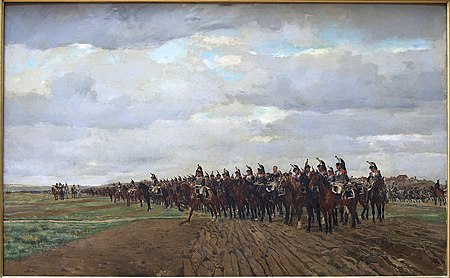
This is my first video done as a narration from the command tent. This time it is from the Coalition command’s perspective. SPOILER ALERT Below the video I am going to be discussing the outcome, so make sure you’ve watched it beforehand!
One thing that is fun to watch, and it is really obvious in the high speed version that runs at the end of the video, is the switch from attack to defense that the Coalition army has to do when they realize that Napoleon has gone “All in.” In the main video, this happens at ~4:30.
This is how the battle is supposed to flow. The Coalition must attack all out, and assume Napoleon has brought on no extra Corps, beyond Davout. Because if he has not, then the Coalition must decisively defeat him, or they lose.
On the other hand, if Napoleon has brought everything, then he must win decisively, or it is a Coalition victory.
When I play double-fisted solo, I roll when the Coalition spots any of the optional HQS (Napoleon, Bernadotte, Murat, Bessiers). On a 4+ Napoleon has brought on everything. Not knowing until that critical moment makes for a fun game. One of the upsides to Pub Battles is that it plays very quickly, so if you have made a mistake, you can play out the battle quickly to its conclusion, without feeling like you’ve wasted the whole weekend.
At the end of the Battle, both of Murat’s cuirassiers attack towards the Pratzen, which is what their orders were. If one were playing by normal Pub Battles rules, it would have been pretty obvious where the IV Corps bags were probably located, and a sharp player would have guessed that and sent one of the cuirassiers to attack it, ending the game with a French victory. However, I chose to play that the cavalry were focused on the Pratzen and the defenders to their front, and that’s how they attacked.
Actually, when I first played, I did attack the bags and end the game. I was tired after filming the video and just wanted the game over with. I also had a fun bit where there was a knock at my door, and I went and answered it, and it was Murat asking for my surrender!
But I didn’t want a win based on meta-game knowledge. Especially when I was so focused on creating a “you are there!” video. Let me know what you think about my 1st person Narration. I will improve with practice. Creating more of the command tent feel. Pub Battles is supposed to simulate the view of the battle from the command tent, with officers gathered around a table with a map on it. Staff officers running in and out with updates from the field, adjusting the map.
Austerlitz16 demo: Schrodinger’s Napoleon
A really fun to play demo. I screwed up with the side that lost. Let me know if you can guess why!
Complex Combat Solution
How to resolve complex combats is an issue in most game systems, including Pub Battles. I have come up with a simple and definitive solution. It comes from my training as a mathematician (I have nearly mastered basic algebra). What I do know is that when combining fractions, you must reduce to lowest terms. In Pub Battles, the lowest terms in complex combats are two opposing blocks. Therefore:
1. Every combat is first reduced to two combatants.
2. Each combat is resolved entirely before another combat begins.
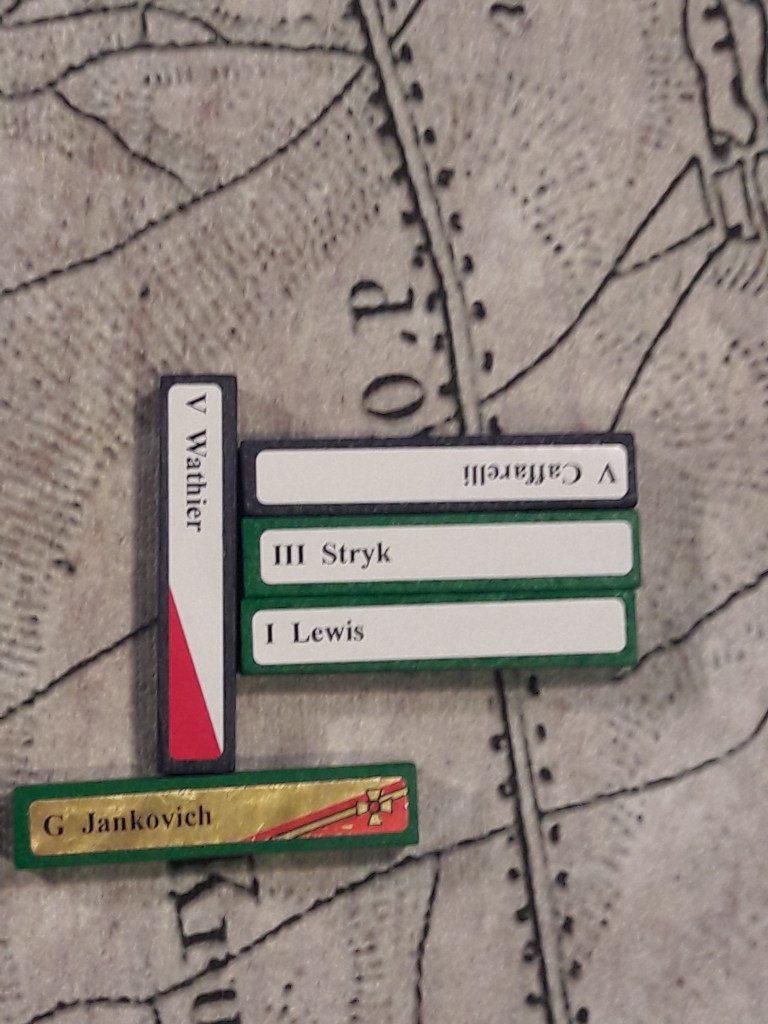
The rules for each Scenario define which side decides the order of combat. As you will appreciate, this becomes significant. The side which gets to decide the order of combats will be referred to as the Tactically Dominant side.
In the above combat, the French are Tactically Dominant, and will likely choose the Wathier/Stryk combat first, if Stryk is eliminated or retreats, then Lewis has the option of advancing to continue the same combat. In other words, the combat is not complete, and no other combat can begin, until the original combat is resolved.
If Wathier wins the combat, there is still the combat between Wathier and Jankovich which will have to be resolved before the end of the combat phase, although it does not need to be the very next resolved.
If the Russians had Tactical Dominance, then it is likely that the Wathier/Jankovich combat would get resolved first. If Wathier lost that combat (likely, since he’s flanked) then Caferelli would be on his own versus Stryk and Lewis.
The other advantage to choosing the order of combat is already part of the rules. The rules say when an army reaches 50% losses, it breaks. The rules don’t specify “at the end of the turn,” so it can be interpreted as immediately. In close games, like my last Marengo game where both sides were reduced below 50% in the same combat phase, choosing which combats go first can stack the deck in your favor. This seems completely plausible when pairing off a commander like Melas, with Napoleon!
Does this unbalance the scenarios? I would argue that it does not. First of all, complex combats are not common. Second of all, the players are aware of how the combats get resolved. A commander knows the limitations of certain troops, as well as what can be expected of certain troops. Pub Battles thrives on asymmetric battles. Few would call Brandywine a fair fight, but most would agree it is a fun fight. No one is ever guaranteed to win, but how much sweeter is victory to the underdog! A fair fight that usually ends in a stalemate is a pretty dull affair.
Alt Austerlitz (Schrödinger’s Napoleon)
I really like Pub Battles Austerlitz, especially with the variable French setup. Are the French as weak as Napoleon says? The Austrians must attack as though they were, if they wait too long to find out, then it might be too late.
For enthusiasts like myself, after numerous plays there becomes an optimal French option, just bring on the Guards and all you need to win is not to lose big.
To keep the game exciting, I use a certain variation on the suggested setup. I can not take sole credit for this, it is mostly a particular variation on the setup that could be chosen. It is also optimized for solo play.
The French player has two options, bluff, or all in. The French always have Soult, Lannes, and Davout (III, IV, and V, Corps),. Alternatively, they can bring on Napoleon, the Guard, Bernadotte, and Murat (everybody). There is no option to bring on just one other Corps.
On turn one, the French player adds Napoleon’s HQ to the cup. He must make a note if it is the real Napoleon, or just a decoy. He does not have to reveal anything until the HQ is seen by the enemy. So far this is exactly one of the suggested options. The difference is that IF the French player does not bring on everything, then all that is available are the first three Corps. Not even Napoleon is there!
It is assumed that if Napoleon isn’t there, then he has come up with a different plan, and needs the rest of his army to pull it off. Whatever he has planned won’t work if his other forces don’t last the day at Austerlitz. He doesn’t need them to win, he just needs them to tie down those Allied forces.
If you are playing solo, it is called “Schrödinger’s Napoleon.” Like Schrödinger’s cat, Napoleon is both there, and not there, until you examine the HQ. When the HQ comes within the Allied LOS, roll a die. On a 4+ Napoleon is there with the rest of his army. Otherwise, only the first three Corps are on the map. If you find it difficult to play as though you didn’t know, then this option solves that.
The biggest difference between this and the official rules, is that the official rules allow Napoleon to appear with one other Corps, and the Austrian must still win decisively, or lose the game. I feel it is tipped too much in Napoleon’s favor if he appears with the guard (besides, the Guard is always with Napoleon), and all he has to do is not lose decisively to win. At least, that’s how it is for me after many, many, plays.
As always, let me know how this works for you!
For an Even more Intense Ending
Victory conditions are always one of the toughest aspects of game design. How you define victory changes how the battle was fought. Historically, the things that were important at the beginning of the battle might not matter at the end. The reverse is also true. Many Waterloo games have Hougomont, that fought over chateaux, as a victory objective. Yet Napoleon was never interested in it, nor was Wellington. Other than it was a great defensive point if the French wanted to waste effort on it. Which they did, and it cost them the battle.
One of the first things you learn, as the French player, is ignore Hougomont. If Wellington wants to pack it with his best troops, then let him have another British island. Soon they will not be in combat command and they’ll be trapped.
Official Pub Battles rules have standard points for eliminated enemy blocks, with multiples possible depending on the condition of the enemy bags. This is necessary for tournaments and such, where a winner must be declared.
I only use points if no enemy bags have been destroyed. Twice in a row playing Marengo I have broke both armies (50% losses) in the same combat phase! So how do you resolve that?
Well, I like the idea of an army breaking at some unpredictable point. That moment when a group’s collective will is broken. Something that you know is close, but you can’t predict. That’s why I am going to say that the moment, the moment the die is rolled, is the moment the army breaks. Not at the end of the combat phase, but the moment that 50% point is reached. If that happens to be the same combat, well then it is a tie, both players lose.
Fire on the Brandywine!
This time, Cornwallis lights up the Brandywine himself, while Knyphausen slams the door. Check this out. Did Cornwallis miss a chance at an even easier victory?
I’m curious what your experiences have been with this Pub Battles scenario, when deviating from Howe’s plan.
 Pub Battles: Home Brew