In Development – Capture the Flag

This is my concept for a non-historical scenario creation system. Like many military “wargames,” the objective is to capture the enemy base.

The idea of buying armies sounds kind of ludicrous. Everyone vying to buy the best army. What generals ever got to pick their exact army? You made do with what you had. The hand fate dealt you. The idea of a fair fight is not a consideration. How well can you do with what you have?

Hence, I prefer a card based system. In this case I prefer a system where each card represents a corps. Some cards will be Fog of War thus the enemy’s true size will be unknown for a time.

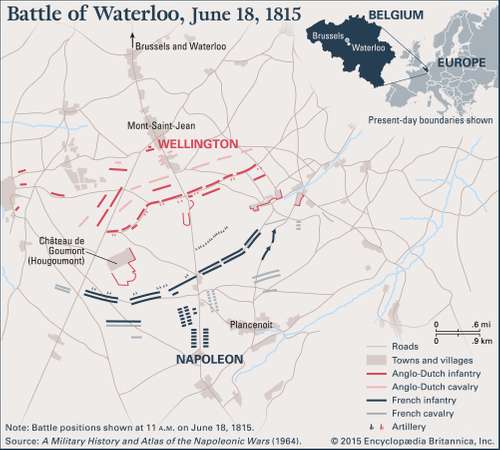
I looked at the Waterloo OoB and observed that the armies both have 10 HQs. The French actually have 10 HQs counting the 4 cav corps, and the allies have 8 corps plus Wellington and Blucher.

My idea is this: I have made a French and Allied deck. Each deck has a card for each Corps + Fog of War cards to bring the total to 12.

Then I made a setup deck. Each card will determine your forces and victory conditions.

Players choose a deck, French or Allied, then deal four stacks of three cards. Next draw two cards from the setup deck. The first card is for the French forces, the second card is for the allied forces. Four cards are special (SSS, RRR, SXX, RXX), if one of these cards is drawn, then both players use that card, if two of those cards are drawn, the second card is used. Each card has a strength rating from 1 to 3. If the strength ratings are equal, then the objective is to control both bases at the end of the game. Otherwise, the stronger army must capture the objective from the defender and hold it at game end, or they lose.

Each setup card will have three letters that the players must assign to each of three stacks, the one remaining stack will not be used. The letter S means these forces Start the game on the map. The letter R means these forces enter as reinforcements sometime during the game. The Letter X means that these forces are not used unless the game continues to additional days.

S forces may set up anywhere within 1 mounted move of your home edge. You may set your base/objective up anywhere at least 1/3 mounted move from your home edge. If you control the larger force, you have no base.

If you have one R stack, starting on turn one you roll a die whenever its chit is drawn and on a 3 or less the HQ enters the map on your home edge, or along either side as far as 1/3 mounted move times the turn number from your home edge. If you have two R stacks then the second stack’s chits are put in the cup on turn two, and on turn three for a third R.

Victory conditions: To control a base or objective, you must occupy it at game end. Games will end on turn 10 unless neither side has achieved victory. If neither side achieves victory, and neither side concedes victory, conduct a night turn and play another day. On day 2, one stack of X forces may now enter as reinforcements. If neither side achieves victory, and neither side concedes victory, conduct a night turn and play another day. On day 3, any remaining X forces may now enter as reinforcements. If no one has won by the end of day three, the game is considered a draw, but they both may claim “victory.”

SUDDEN DEATH if at any time a player has eliminated 50% of his opponent’s army, he wins immediately. 

If the Guard is not in play, the French player begins with Napoleon as an Army Commander (and the chit), but without the Guard. If the Guard is part of an R deck, Napoleon does enter play until they arrive!

The Wellington and Blucher HQs are always present as soon as any of their Corps arrive on the board. Wellington and Blucher have no chits and may activate once per turn with any subordinate HQ.

Fog of War HQs. For every Fog of War card you draw, select an unused HQ and add it to your Start or Reinforcement forces. If your total army does not allow you enough unused HQs, you forfeit the Fog of War cards.

Fog of War HQs serve two purposes. The first is to mask your forces, the second is to scout the enemy. FoW HQs actually represent cavalry scouts. When two enemy HQs come within LOS of each other (foot move range) they reveal their identity and they must place their units as if spotted, or remove the HQ if FoW. Army HQs are revealed as regular HQs, but no troops are placed if they don’t have any assigned to them.

Spotting – any time two opposing HQs have LOS (one foot move), the players must place the corresponding units on the map (the opponent still won’t be certain of the identity). Fog of War HQs actually represent scouts who have raced off to report the enemy’s position (and the HQ is now removed from the game).

To calculate the size of the army, count the number of blocks for all Corps drawn (including those arriving as reinforcements). Do not count HQs or Baggage Trains. The strength of the Corps are included on the cards for ease of calculation.

Loss calculation:
Add up infantry, cavalry, and artillery blocks eliminated
Elite count as 2 blocks lost.
Baggage Trains count as 2 blocks lost.

You are not required to include a Baggage Train with a corps.
Baggage trains 3.0

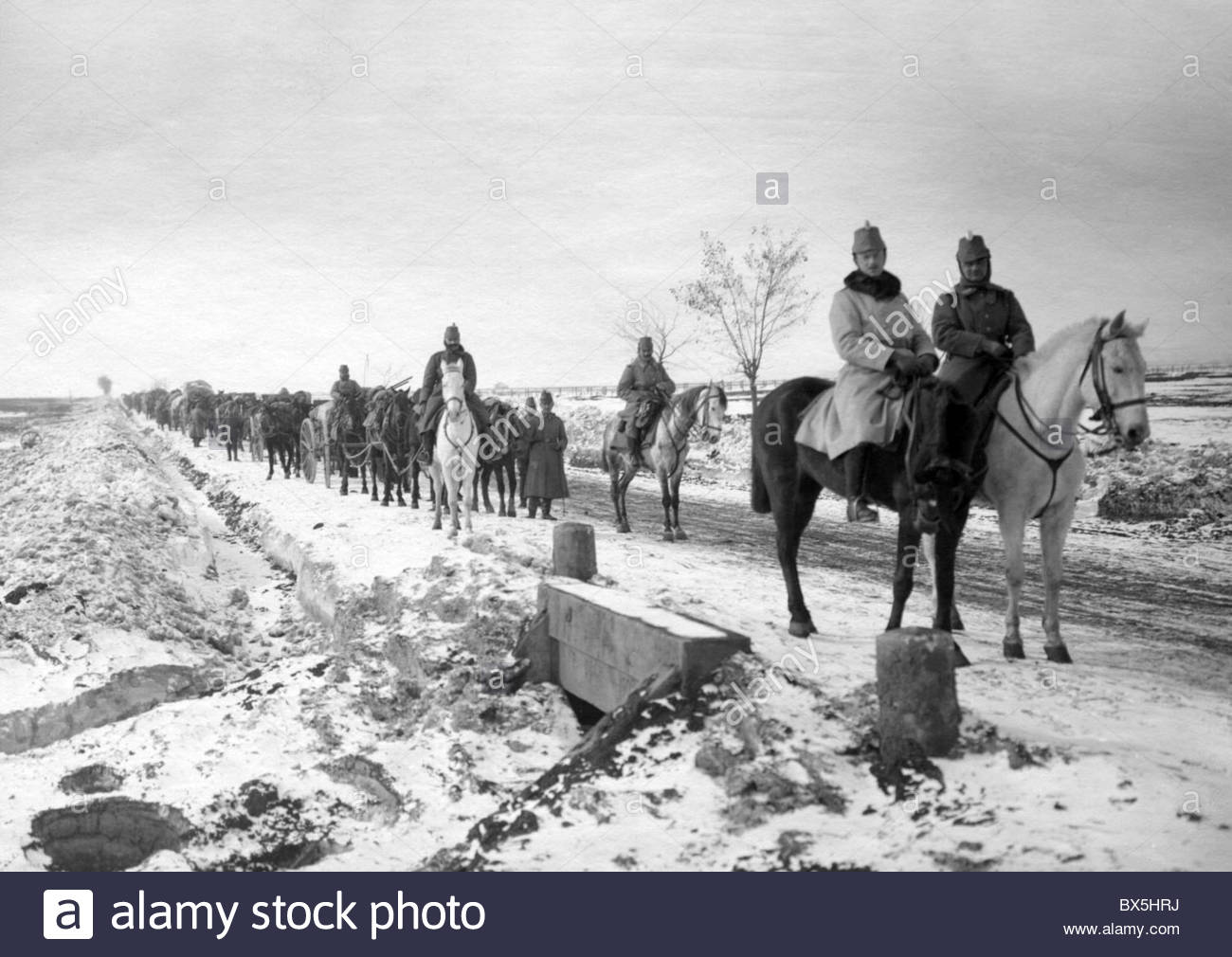
With the Baggage Train rules of 3.0 baggage trains have finally found their place in the Pub Battles system. Pub Battles originated as a way to play a referee-less Kriegspiel. Baggage Trains are represented in Kriegspiel, so they were included in Pub Battles, but without a referee, their inclusion wasn’t quite right. Now they have a central purpose, without a lot of baggage (pun intended).

Victory conditions are always a sticking point in wargames. You want to reflect the intentions of the commanders going into the battle, the realities that changed those intentions during the battle, and the reflections on what the battle was really about in hindsight. The only constant was that if you destroyed the enemy’s army, you won. Not every battle was fought until one of the armies was destroyed, more often the opposing commander chose to retreat, or worse, the troops broke and the army’s coherence dissolved. trying to decide on Victory Conditions raised a lot of questions.

The 3.0 Baggage Train rules have answered all those questions neatly and simply. You still win by destroying 50% of the enemy army, but on your way to doing that you can also break the army sooner by destroying their Baggage, or force them to exercise discretion and bail out in some order, to fight again another day.

First off, let us understand what is meant by a baggage train. The baggage train is pretty much what its name implies while packed up, but when it is unpacked it represents something more. An unpacked baggage train is a logistical Wal-Mart, plus a field hospital, plus a signal corps, plus all the other myriad functions to address that arise when an army makes camp to support operations. It is not something you can pick up and move on a whim, or in the breach. When your enemy moves adjacent to your baggage train and breaks your army, it isn’t like in ancient warfare where your bags are literally getting sacked. Instead, it captures that figurative moment when the line has been broke through and the troop’s morale fails. No one can ever predict when that moment will happen, but everyone knows there comes a time. Without a referee to tell you this, Pub Battles uses this mechanic. This gives the right feel to the battle.

When you decide to unpack your bags as the defender you have to weigh being close enough to easily and quickly recover spent divisions, while far enough back to not be too vulnerable. That is the easy part, but the devilishly tricky part is deciding when is a good time to unpack, as well as exactly what determines too close and too far at that time. This is an art that requires an accurate instinct more than in-depth analysis.

For the attacker, the issues are similar, but the ramifications are different. You need your bags unpacked to keep your attacking units in fighting shape, but if you setup before the enemy, they are likely to fall back before they unpack, leaving you wasting valuable time traveling back and forth. With only eight turns in a day, a turn falling back, another recovering, and another moving back to the line, means you’ll be lucky to see two fights in a day!

Finally, a strong point to the baggage train rules is they simulate logistics without the tedium that is so often anticipated when encountering logistics in a wargame.

After using these baggage rules in a few dozen games, I can definitely say they “make the game.” Originally, I thought of them as sudden death because it didn’t require that you eliminate 50% of your opponent’s army. Now I find that many of my games do end up with one side losing 50% because of the fights over the Baggage Trains! This has really upped the tension level of the game.

I can even quantify why the level of tension has increased so much. First off, the game starts out more tense because you aren’t whittling away hit points on units, a process that can take the whole game. With Pub Battles, entire divisions can be lost in one turn, though rarely without a player’s chance to withdraw. Making it entirely possible to reduce an army to the breaking point in less than an hour of game time.

Then you ratchet that up a notch by adding baggage trains that must be kept reasonably close to the front lines to be effective, but end the game if captured.

The effect of THAT is to see desperate battles over the Baggage Trains that can easily push one of the armies to the breaking point. The possibility of a dramatic end is rarely more than the next combat result.

This is Pub Battles. This is war.

Solitaire with Written Orders!

Hold Roundtop

One of the best things about Pub Battles; one of the things that separates it from so many other titles, is the way it distances the players from the God-like ability to see all and do all with absolute precision and perfect knowledge.

Playing solitaire with written orders takes this one step further.

It accomplishes this with a simple an elegant system that gives an authentic feel without burying you in rules. It removes you from too close control, while inserting you right into the chaos of battle.

How It’s done…

I have tried various combos of specific and conditional orders, all of which proved unnecessary! Simple is best. Just write down a location or range (from here to here) and the HQ will attempt to go there and control the area. If they are in that location, they will defend it. How wide a latitude you want to use to interpret those orders is up to you.

I have also used the orders to attach a unit to a different Corps.

If an HQ has units on its reserve card, I just write the unit’s name and enclose it in brackets.

How it Works

At the beginning of the game, any HQs on the board must be given orders. IF an HQ is without orders, its units will just sit in place.

When a chit is drawn and activated, the first thing the player does is check the orders. If the last order given is not underlined, he underlines it and then carries out that order.

If he wishes to change the orders, he writes the new order underneath the previous order. He then carries out the previous (underlined) order. Next turn he will continue as above with the chit draw and activation. (See optional hands on opportunity below)

The first time a Corps is activated (either on turn one, or when it enters play as a reinforcement) it is given its first set of orders underlined, so it’s not sitting without orders for a turn.

Army HQs – If the Army HQ is adjacent to a Corps HQ, that HQ’s orders take effect immediately. Write and underline new orders.Since the two commanders are together, there is no delay in sending orders.

In effect, this allows you to insert yourself right into the game!

Baggage Trains: Baggage Trains move when their parent Corps moves, but they do not have to follow its orders. They may move and Position themselves any way they want.

Night turns: During night turns the corps ignore their current orders. Additionally, they may be given new orders and those orders are underlined immediately, so they always begin the day with orders!

Order Roster

Here is a simple sheet to track orders: https://docs.google.com/spreadsheets/d/e/2PACX-1vTITgxL-yIJnmwOkN67Mo4V5MEAogdaNFmMObjdr75EDDQijivriOF0smfW_HhZ3P2jKzcdj64O_ub0/pubhtml

And that’s it!

Well, almost. Just like real commanders, you will find that your orders leave a lot of freedom of interpretation. Maybe there is a unit just out of direct line between a unit and its objective, should it attack that unit first? You decide.

This is one of the best features of this solitaire system. You control the narrative. You decide whether or not the commander on the ground decides to widely or narrowly interpret the orders.

Maybe the dice have been a little too hard on the Confederates side. Let’s show them a little love and interpret the orders most beneficially. On the other hand, maybe the dice have been giving Lee a free pass, it might be time to attack the objective with A.P. Hill’s lone spent element of Heth’s division, even though it’s got Howard’s whole fresh Corps behind abattis in the woods. Oh Harry, you’ll be bringing tears to many mothers tonight.

The first day of Gettysburg won’t make you feel that frantic, but guaranteed, as day two wears on you will find the battle going in directions you have probably not anticipated.

In one game, the second day opened with the Union in a strong position along historical lines, by the end of turn 3 the only comforting position that greeted Meade was V Corps taking Wolf’s Hill from Ewell’s Corps. Longstreet had captured Cemetery Hill and A.P. Hill was investing the Peach Orchard.

This would not have happened if I had been free to move my troops wherever they obviously needed to be. The scenario went from a replay of History to a very edge of the seat, bare knuckles contest!

One of the biggest differences you notice is the lack of a fireworks display of unit moves, as each division angles for the best attack. Now they have to act in much more historical coordination with their parent HQ. That parent HQ is going to be operating with a one turn delay in changing orders, so gamey moves that take advantage of the players god-like knowledge of the battlefield and unit strengths and positions will no longer be possible.

Optional hands on opportunity

I like having a lot out of my direct control, but if you want to interject some control, try this: When you elect to change an order, if you flip your HQ and make your command roll, you can ignore your current orders and the HQ is treated as being without orders for the current turn and new orders are written to be followed the following (no pun intended) turn.

The HQ is communicating the need for new orders and is not following current orders.

Two Player with Written Orders

Two players may play with written orders, but it is probably too open ended for truly competitive play.

Whenever you give an HQ new orders, you show your previous orders to your opponent, so he can immediately verify you followed them.

Of course, if you have a referee overseeing the game, hidden orders can be fun.

Kriegspiel Remote!

One of the most enjoyable ways to play Pub Battles is remotely. This requires two players and a referee. They can be sitting separately in the same Pub, or in completely different locations and time zones! This gives an authentic Kriegspiel experience because the players have very limited information of the positions of any combatants. They only have the locations of their HQs. They have no say over the divisions or other subordinate units of their Corps.

The player maps don’t need to be the game map. Its more fun, and authentic, to just print out historical maps and gives those to the players.

The referee sits with a copy of the game and an order sheet with all current Corps and orders written on it. He texts the players that he is ready for turn one orders.

The players each have their maps with the starting positions of their Corps HQs and any knowledge of the enemy positions the Referee cares to share with them. They submit their turn one orders, all of which are immediately carried out by the Referee.

The players patiently wait, enjoy their beverage of choice, chatting with nearby friends, while studying and overthinking their plans. 😉

The referee draws chits, carries out orders, and resolves combat. When the turn is complete he texts a dispatch to each player reporting combat results and any changed positions. He also let them know the deadline when their next orders are due.

Players are allowed to text one response to any text from the Referee. They can send additional texts, but additional texts have a strong likelihood of being misinterpreted. The referee’s general guidelines are that the first text is carried out automatically, any additional text requires a check for success (4+). If an order is unsuccessful, the ref has discretion what that may mean. The orders (any sent, including the first) can be misinterpreted, lost, or even captured. The players have no way of knowing.

Notes for Refereeing – Your roll as referee is a fun way to play Pub Battles, as you get to play a game solo with two opponents submitting orders. Here are some general guidelines to make sure the players have a fun experience:

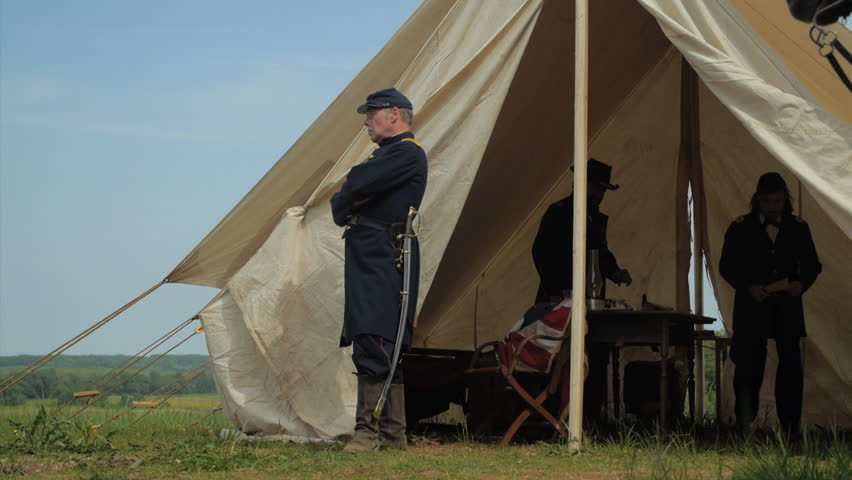
Try to make the experience of them sitting in the command tent as authentic as possible. You can add personality to different commanders, as well as adding game info for color. Commanders can be begging for supplies to recover their depleted divisions. Try to give the players enough info to make deciding when and where to unpack their baggage Trains.

In general, try to provide them with all the info you can. Even if you tell them precisely all the information they need, they are still going to feel like they are boxing with blindfolds. You can tell your players are too confused to be having fun if they start disengaging or writing silly orders.

As you draw chits you can play with the order they are drawn, or you can adhere strictly to the draw. The goal is to make the game interesting for the players. Use chit draws and combat dice as guidelines.

While insuring the players have a good time, you want to avoid teaching players that whining works. Life isn’t fair, and war is worse. Make Corps commander’s personas and abilities come alive. A successful Referee will have players trusting some commanders and not trusting others with important tasks.

In my variable leaders variant I give suggestions on ways great leaders and poor leaders can differ, and this might give you some ideas.

Good luck and Good gaming–Please let me know how your games work out!

What if: Stonewall at Gettysburg!

End of Day 1

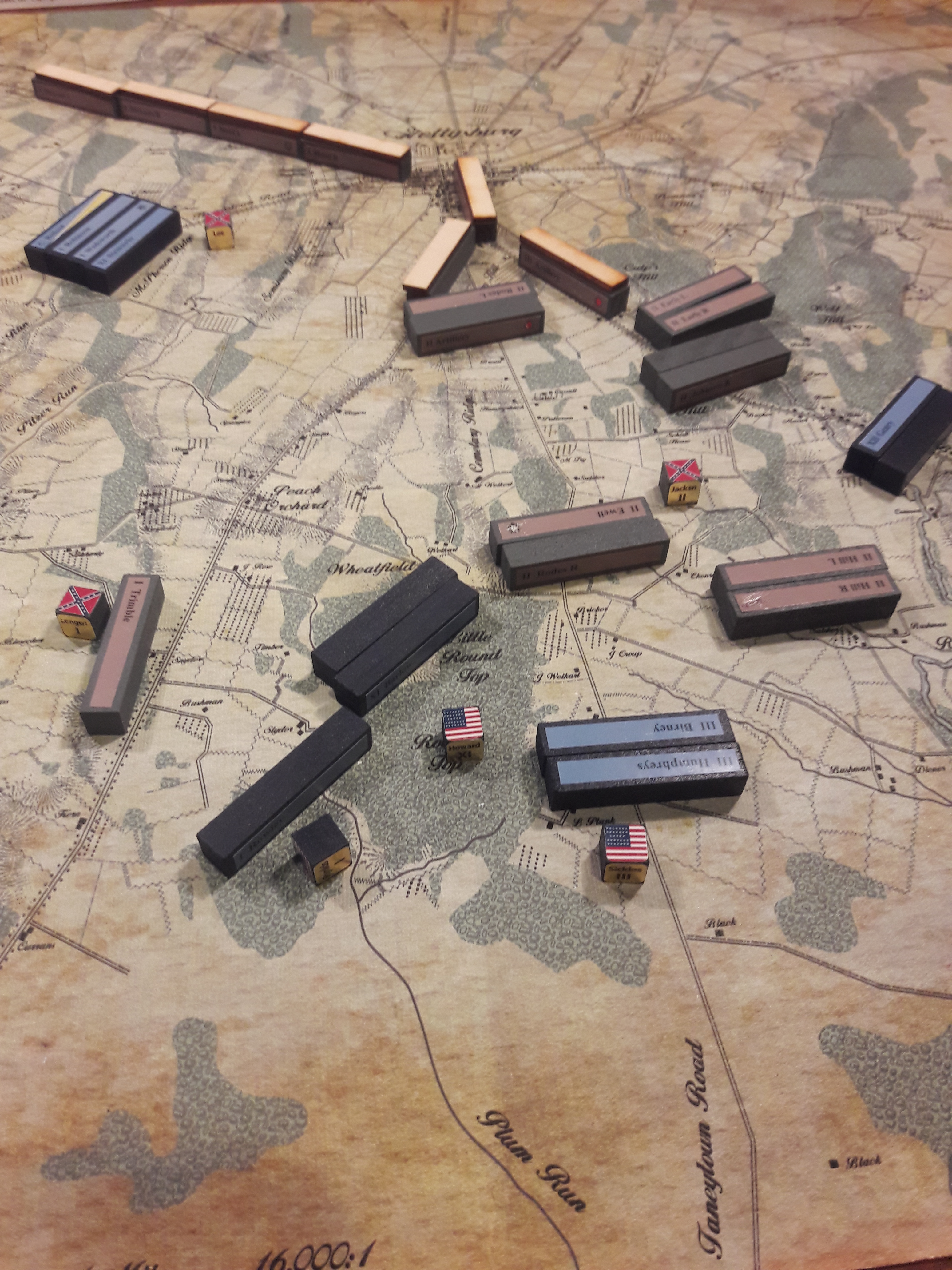
With this scenario (all the components are provided with the Gettysburg game), the players get to try their hand at a great what if. What if Stonewall Jackson hadn’t been killed at Chancellorsville, instead he survives his wounds. He is unable to affect Lee’s strategy, but he does rejoin the army soon enough to be present at the battle. In fact, displaying his decisive elan, he gets his Corps there sooner. The leaner original two Corps Army of Northern Virginia fights a different Battle of Gettysburg.

In this foto above, of the end of Day 1, you can judge for yourself what the outcome was.
The lost divisions were all Union, including Buford who made a heroic, though foolish, attempt to stem the rebel tide.


Other than Trimble skirmishing with Reynold’s troops, Longstreet’s Corp has just arrived.
The Union’s glorious dead are being watched by Lee on McPherson Ridge.
On to Pipe’s Creek! 

Compared to the Historical Scenario:

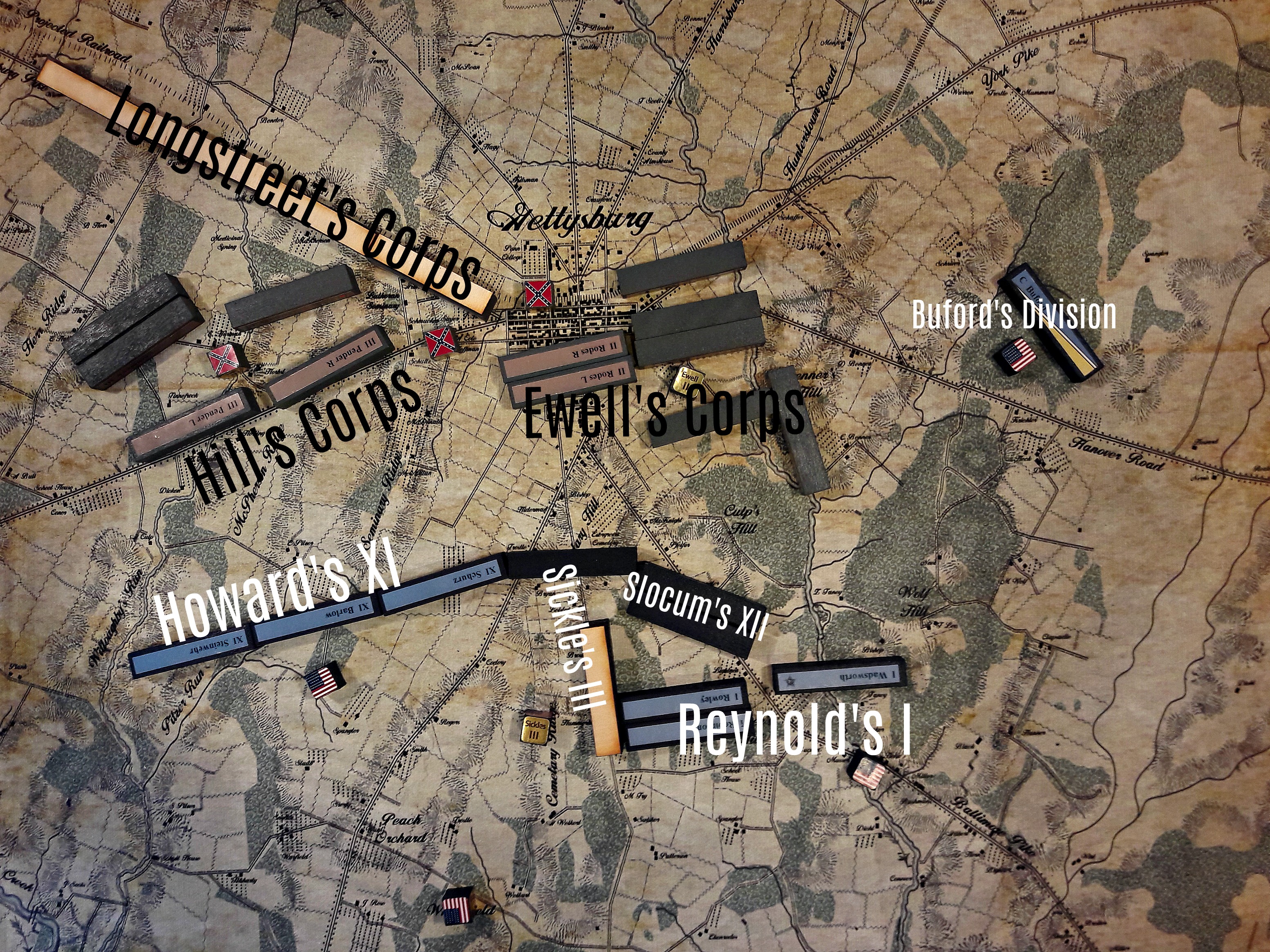
End of Day 1

Here is the end of the day of the Historical scenario. Ewell’s corps arrives a turn later than Jackson’s does in the scenario above, and what a huge difference that makes! Suddenly the Union troops don’t seem quite so overwhelmed.

However, I for one, shall be very interested to see how this plays out. The Union has already had to fall back beyond the North edge of Cemetery Hill. During the night turn the massive Union artillery arrives, but where will it go? Would Meade have ordered a withdrawal to Pipe’s Creek, where he wanted to make a stand? Interesting questions, indeed!

Check out my Gettysburg Victory Conditions.

More combat rules?

In spite of the fact that Pub Battles focuses on command, many people want the combat rules more detailed and fleshed out.

I have no question that it would work. The system is robust. My concern is that the system will lose its authentic feel. Combat decisions should be quick and direct. They should not founder on specific weapons and tactics that are the domain of lower level commands.


Pub Battles has a very simple combat results process. Any “improvement” is going to add to the complexity and force players into micromanaging their forces.


This level of detail isn’t appropriate for an army commander, that’s why he has lieutenants,  and that’s where command headaches start, because unlike a player, he can’t be everywhere on the battlefield. 


Command Post Games has the right name. Pub Battles simulates the army commander back at the command post.


He writes his orders and an aide dashes them off to the field. He hopes that they get carried out. He hopes the info he has in front of him on his map is accurate! Will this be another case of the orders making no sense? Will the Corps commander have to confirm them, given his present situation? The clock is ticking.


All the commander has is the best estimates of enemy (and friendly, for that matter!) strengths, conditions, and positions.


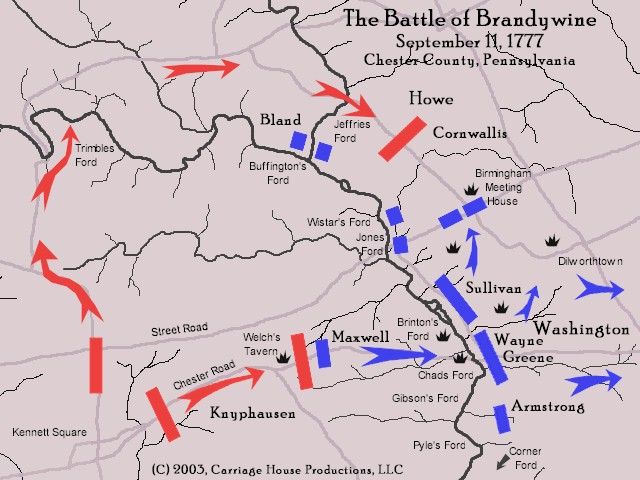
When I played Brandywine double blind with Marshall (PBs lead designer) reffing, I got a genuine feeling of the kind of command fog that he was striving for with Pub Battles. I was on pins and needles! I’d send my orders off and desperately wait to hear back. At no time was I plotting exactly how far a block could move, or exactly what angle it was facing. I just wanted to know if they ran into resistance and whether or not they overcame it, or were running away in terror.


It was after that experience that I got a real feel for what Pub Battles was capable of, and how close it came to authenticity.


I agree with Frank Chadwick when it comes to modeling command in wargames. The trick with strategic command isn’t how to bring the player closer to the action, but how to remove him from it.


To that end,  I see any rules changes which focus on combat, or on giving players more control over their units, as being counter to the best and most unique feature of the system.

How can a unit just sit there?

Many players are frustrated when they see one of their units easily within weapon range of an enemy unit and yet the game does not let them attack. Perhaps the unit in question was only a third away, moved to contact, and then the enemy went second and backed off just out of contact.

My view of what the PBs system is actually showing you is just what is shown in your command post. It is not what is actually happening on the battlefield and this is often why units that “should be engaging” are not. If they are close, they may very well be engaging, but not effectively enough to show effects at the divisional level.

This is why the chit draw may leave you feeling frustrated and stymied, when the real solution seems obvious. Yes, that’s exactly what they would do…If they understood their orders, and If they felt they were secure from other attacks, and If they are certain of the other unit’s identity, and If they are actually where you think they are, and If the enemy unit actually is there as well.


That’s a lot of ifs!


These are all frustrations that a referee will ladle out generously in a kriegspiel game, and these are the frustrations that the Pub Battles system ingeniously, and without remorse, muzzles the player’s intentions with.

What this means is that you should feel removed from the battlefield. The game wants you to face what real commanders of the time faced. They couldn’t be everywhere, so the commands were delegated to lower echelons and the commander sat in the command tent, getting reports and sending orders.

But couldn’t a real commander leave his tent and see for himself?

Yes they could, and they did. This is exactly what is happening when you flip your HQ cube and roll to Alter Turn Order! This is that seminal moment when the General steps out of the tent, climbs on his horse, and takes personal command.

Solitaire Pub Battles

This is my unofficial Home Brew version of Pub Battles. This is the way I play when it is just me. Not a true solitaire game, there is no AI, but just a way of playing when no opponent is present. Pub Battles is well suited to solitaire play as it is simple and the chit draw serves as a convenient ‘save point’ if you get called away.

One of the ways I frequently play Pub Battles solitaire is as a simulation engine. I have an idea for a different strategy or I want to try out a new rule with a familiar strategy and this let’s me “run it through” a few times. Pub Battles plays so quick and easy that this is a viable option.

Pub Battles is an amazingly robust system. I have seen many different rules tried (and mostly discarded) and the system works with them or without them.

Of course you can always add rules that factor in this or that. You can always add different combat modifiers and effects that give the game a slightly different feel. Maybe there is one thing that blocks your enjoyment of the game. Fine, add it in and have a blast.

I generally go the other direction. I try to eliminate every rule that isn’t absolutely necessary. I find this speeds up the game. The whole point of the rules is to focus on command interaction, and simplify and gloss over combat detail. This is the main reason I developed a single die per side combat system. It’s quicker and easier. Not a huge difference, I am happy to play “the right way” when playing in public or introducing new players to the game.

The really cool thing I find about this is that by not specifically trying to model one thing, the system models everything in general. So let’s dig into my version. I’ll add my designer’s notes in italics.

All official Pub Battles rules are in play, except as modified below:

Alter Turn Order – For the most part, when I play solitaire, I just deal with the chits as they are drawn. This forces me to learn to roll with fate. As a consequence, I rarely try to Alter Turn Order when playing versus a live opponent!

Combat

  • Developer’s Notes

I don’t care for Field of Engagement. I find it time consuming and inelegant. No unit is ever necessarily just sitting, they are always in motion. Their fluid movement is chopped up by the arbitrary turns that are superimposed over the battle simulation. In addition, there are plenty of incidents where a unit did not do what it should have done, maybe they didn’t recognize the identity of the unit, maybe they were confused about there orders, maybe a regiment got lost, or the commander just had cold feet. All the game shows are those combats that actually were executed to the extent that resulted in an entire division suffering some sort of dramatic effect. Also, all you are really seeing is your best intelligence as regards the unit’s position. Maybe it’s not attacking because its not precisely there! Hopefully, your next orders will make sense for them to follow (or will they have to write for clarification?). The system doesn’t attempt to tell you precisely why a unit did or didn’t follow your orders, it merely shows what happened.

Field of Engagement doesn’t allow for implied combat. Nearby units may be exchanging shots and the pickets or skirmish troops may even be engaging in some very hot exchanges, but nothing that results in the parent divisions being adversely affected to the extent modeled in Pub Battles.

Flanking by merely having a single unit attack along the side of a block is gamey in the sense that it takes advantage of the wooden block’s inability to curve and deny a flank the way actual formations did.

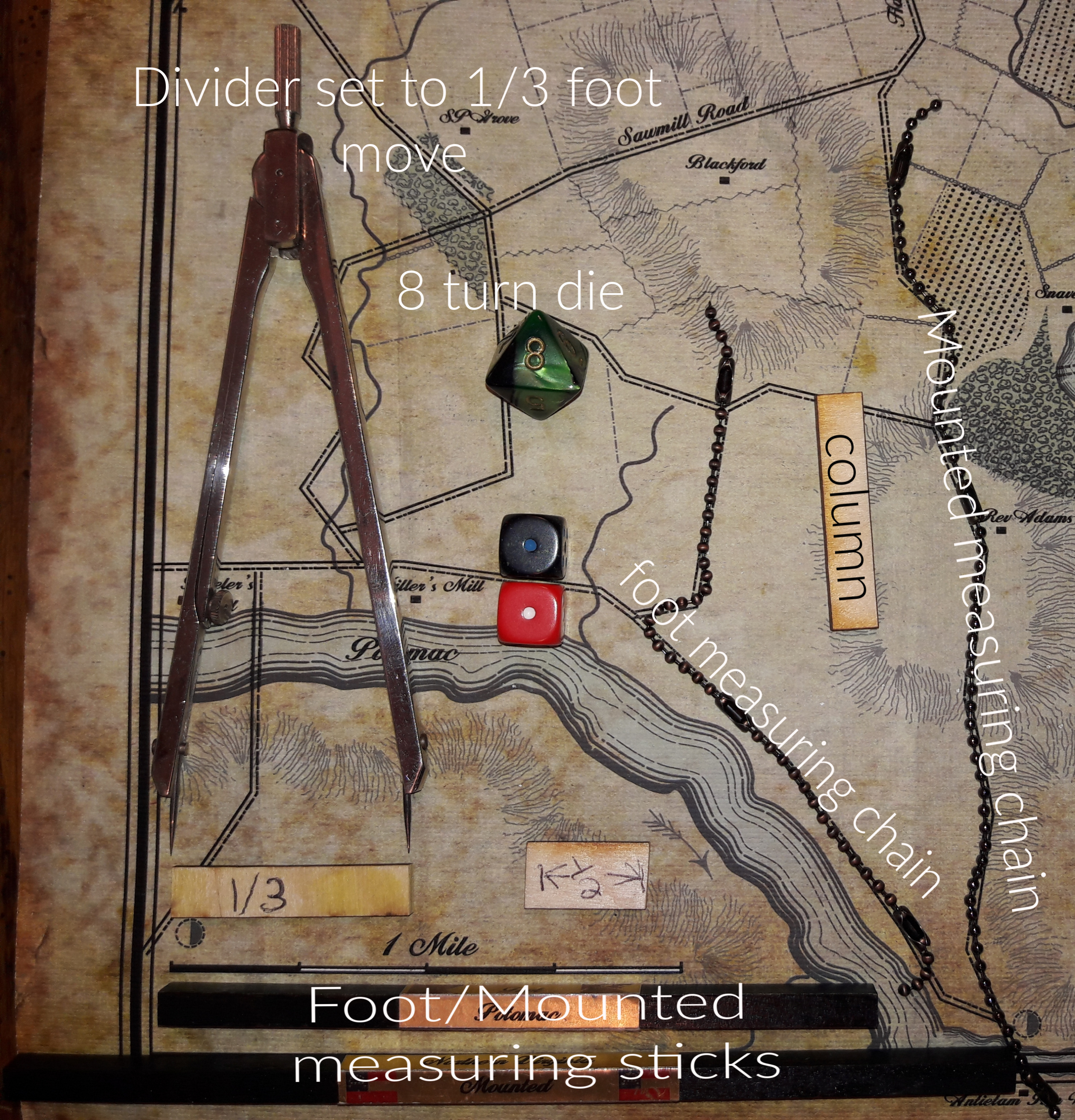
Tools of the trade

Pub Battles can be played with only a few key elements. My philosophy is the same for rules and accessories, the fewer the better.

Listing from the top and going down are:

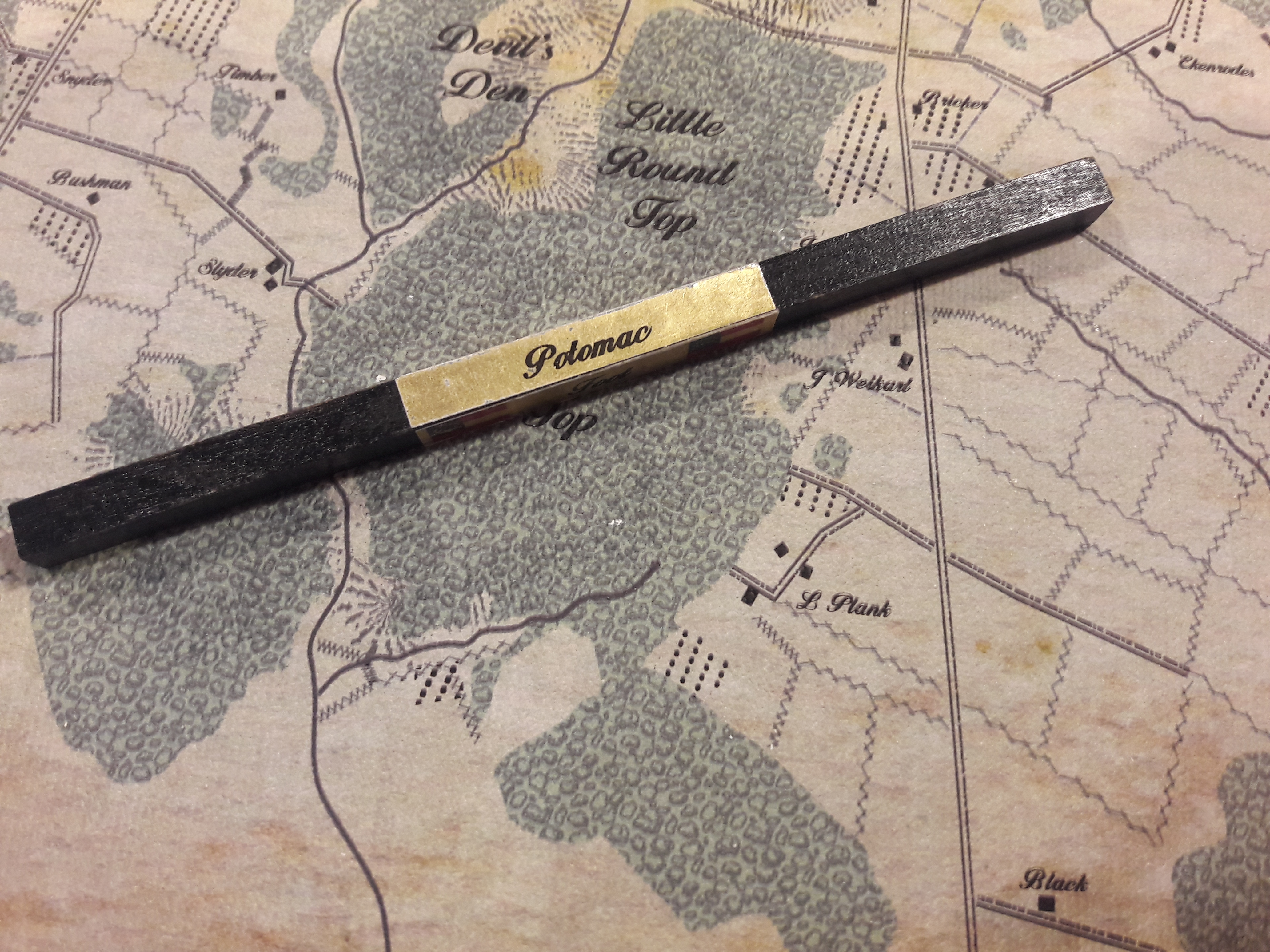
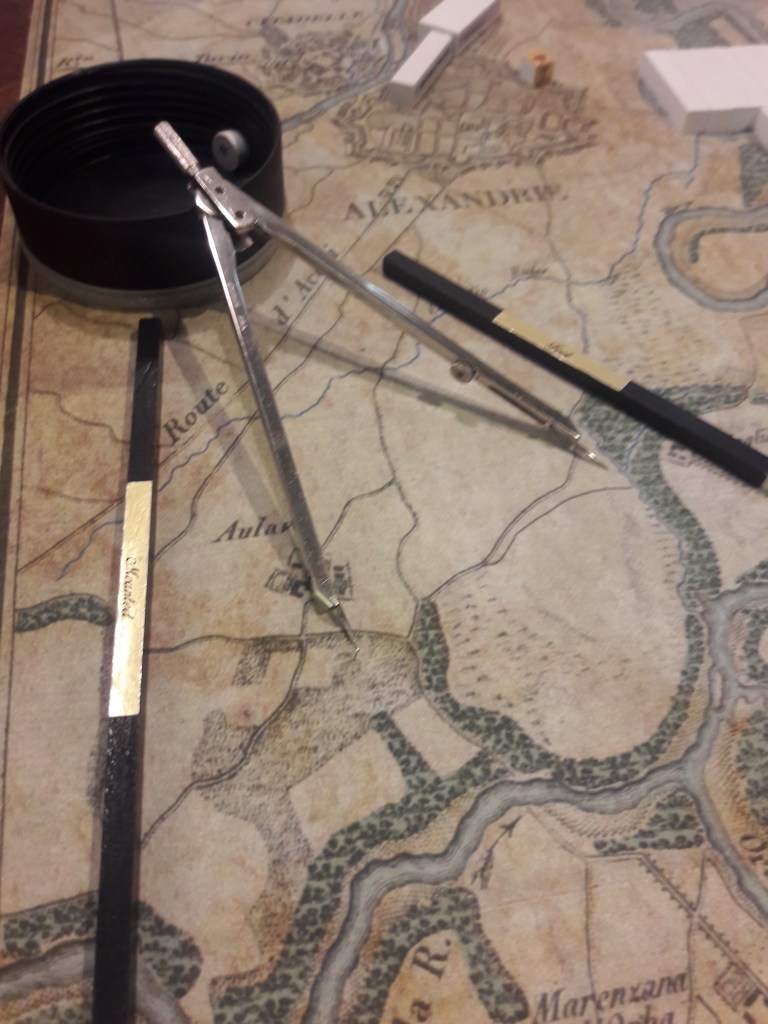
Divider – Similar to a compass for measuring angles, I set the divider for one third foot move and use it for nearly all game purposes.

“Mounted” measuring chain – These are included in the price of the game. they are also really handy when you are moving in column along a road. Racing units to the front is important, and you (and your opponent!) frequently will want to be accurate as to how far you can move.

“Foot” measuring chain – Ditto.

Eight sided die for keeping track of turns and six sided dice for combat – Most game days are eight turns (12 hours) long, so this is handy. The games come with a nice black six sider for keeping track of turns, which works perfectly well. Each game includes 6 six siders for combat.

Column movement marker – This is a handy little item that I buy from an independent producer https://tregames.com/ Command Post Games provides blank unit blocks that work fine, but I like to use these because I like the way they look. When I am on a major road in column, I just set them on top to show the unit is in column. Some day I may get around to painting them and mounting cotton “dust” columns, but don’t hold your breath. They are all blank, the “COLUMN” label is just a graphic I attached in the foto.

One third foot move marker – This is handy for quickly checking retreat distances and range if you are using the Field of Engagement Rules.

Half unit width marker – Units require a half width worth of clear terrain to move past without paying the terrain cost, plus you must be able to see half a block to target it for artillery and reach half a block to contact it for combat.

Foot move measuring stick – These are the measuring sticks that come in the basic kit that you must by to get the basic rules. It might seem like they are just trying to nick you for a little extra money, but the actual intention is to keep the overall cost down so you aren’t forced to pay for the same basic equipment every time you buy a different scenario.

Mounted move measuring stick – Ibid.

There you have it. That’s the whole kit and caboodle that I use when playing. Actually, I pretty much get by on just the divider and dice. Additionally, there are no combat tables and the terrain chart is easily memorized after a game or two.

I have added another item. these jewelry boxes make great storage trays for the blocks and fit inside the tubes.

The Cost!!!

Many folks look at the cost of Pub Battles games and complain that they are just too expensive, especially for a game that is so easy to play! Maybe if it were buried under an impenetrable 100 page rule book and had lots of charts and tables and was completely unplayable…

I don’t mind paying a lot for a game that I play a lot. Especially, if it has truly beautiful components. FYI – I own every pub battles title and I paid full price for them. In case you’re thinking that I get them for free because I’m a play tester.

It is important to note that the price people are complaining about is the top end fully loaded Cadillac version of the game with all the bells and whistles, including the canvas map. It is possible to get a perfectly fine copy of the game with a paper map (nice Quality) and you will have to make your own measuring sticks (a template is included). You still get wooden pieces. You can get Brandywine for $62.66, and Antietam and Marengo for a little more. Even Gettysburg can be had for as little as $83.25.

If that’s not cheap enough, you have a chance to get the games for free if you send Command Post Games a picture showing you playing a game in public (you will have to buy the first game). Check their website for details.

The only drawback to buying a paper map is that it is not as durable as a canvas map. I play these games at bars pubs and they get spilled on, set on messy tables, you name it. The canvas wipes clean. I have several games that I have played over a hundred times and the maps still look brand new!

I realize that at over $50 these games are expensive. Too expensive to just throw your hard earned money at on a whim. I hope that after reading a few of my introductory posts you might be inclined to take the plunge and try one out!

My Smooth Brew 3.2

This blog will be updated from time to time as I find smoother and cleaner ways to play Pub Battles.

I am happy to play with the tried and true “official” rules. Pub Battles is quite a robust system and you can add all kinds of rules. These can be fun or satisfying, but most are unnecessary. I am very leery of adding any rules, other than those that smooth or speed play, as the system can quickly bog down. Remember, Pub Battles is first and foremost a command simulation, not a combat simulation. Most of these rules add some time if you incorporate them. Consider them very optional!

Title in bold. Rule is normal font. Discussion/clarification in italics.

Cavalry – Foot retreating from mounted are eliminated.

It just feels wrong to resolve a round of combat, mounted charging foot, and then have the foot pull back while the cav just stands there! Note: this isn’t talking about the chit draw (movement phase), but actual combat!

Artillery – Spent Artillery may fire.

Originally, pre Baggage Train Rally rule, blocks just rallied from spent automatically if they didn’t move. So the proscription from bombardment felt right. Now, with an unpacked Baggage Train required to rally, it is too harsh. If you don’t rally your artillery, it is still very vulnerable, just not nearly useless! Instead of being a new rule, this is just eliminating an old rule!

One Hit on Fresh Block — A fresh block that suffers one hit may either, flip to spent, or fall back Fresh.

Of course, Militia do not have this option.

Support – Supporting blocks may choose to suffer any of the hits of the unit they are supporting.

This makes more sense when Infantry are guarding Artillery, or if you imagine the two defending blocks half as wide and double deep. You can also imagine elite troops or Grenadier Regiments, “stiffening” the line by ignoring the first hit.

Artillery cannot support in combat, but if it is moved into a supporting position it may swap positions with a block that can support it.

This makes it possible to add Artillery to the line without requiring extra turns to get the right chit draw to allow one block to move forward while the other moves back, which isn’t what is literally being simulated anyway!

Woods

Define defender as the block being attacked. Both blocks in combat would be defenders, in turn.

1) A block in woods cannot recover from spent.

2) Command range does not extend beyond LOS in woods.

Although Corps commanders did not need to be present in woods, having forces operate in woods, out of sight, was a drain overall on command resources, hence the need for close presence in heavy woods for offensive operations.

Detachments

Detachments don’t flip other blocks when they retreat through them.

This rule will become part of the official rules whenever the next version comes out.

In furthering the role of detachments as light troops, I am currently experimenting with them being able to retreat from other foot troops before the first round of combat as having the same capability as dragoons

The role of detachments has expanded from FoW, to simulating the presence of light troops as skirmishers and screens.

Combining HQs and Baggage Trains

This is very experimental. Baggage Trains are no longer used, but every Corps, in effect, now has a Baggage Train.

HQs are moved first, any block within command range of its HQ (or the Army HQ) after its movement, may attack an enemy, or Rally.

If the Army HQ is eliminated, no Blocks may rally.

All HQs are recovered during a night turn, HQs may not rally blocks the turn they are recovered.

It is important with this rule to decouple one’s notion that the HQ represents the actual officers themselves! The HQ block represents the entire command and logistics nexus for the Corps. Even when eliminated, the actual command cadre still exists in some form, although key officers may have been lost.

Written Orders

I have found that I don’t care for any written orders rules when playing Pub Battles. I find they sound cooler than they end up being. When I play solo, I use my own judgement based on how the situation looks to the HQ in question. I find this “narrative dependent technique” is more satisfying.