A few notes on the Setup, and a video guide as well.
Item one: The scenario rules say that a detachment may occupy Cliveden (Chew House). What isn’t as clear is that the British may setup with a detachment in Cliveden.
Item two: The British command rules are clearly explained and I still go it wrong! Let me restate it here. Knyphausen and Cornwallis appear on turns 3 and 5 respectively. The British start with Howe in command of all British forces and they move when Cornwallis chit is activated. On turn 3 when Knyphausen arrives, his command activates when he is drawn, and Howe activates with Cornwallis’ troops when Cornwallis’ chit is drawn. When Cornwallis arrives on turn 5, he takes over his command and Howe acts as Army Commander, providing combat command to all British troops in range of his Block.
Alright gang, here it is! The new Pub Battles: Germantown scenario. My first play is a little rough, but like the historical commanders, I ain’t never done this before! A quick game stretched across 6 minutes, so I can explain a couple things. I still left a lot out. I cut the hour and a half game to 19 minutes of talking and explanation, then I cut it still further to about 6 minutes of action with just a wee bit of explication. Your welcome! Let me know in the comments if you have any questions.
Soon to be released (I’m betting in a fortnight, barring any hang-ups) is the Pub Battles: Austerlitz scenario. The price point they’re hoping to be able to hold to is around $100 for the Cardstock map, and $140 for the canvas map. You know me, I’m all in for the canvas map. However, short of any concerns about getting ale or salsa spilled on it, the cardstock is a perfectly viable option. I love the green hue of the map!
I apologize for totally missing the boat on the Germantown scenario release. My copy is on its way post haste dispatch, and I hope to be doing an unrolling video and first playthrough, soon.
I am really focusing on “putting on my command beret” when narrating my videos. I’m trying to avoid game terms, except when necessary for clarity. My intent is to create the feel of the battle. What I have realized is just how good a job the game does in simulating command concerns. This is really apparent in my last Antietam video.
In the middle of the game, the Federal drive stalls for lack of supplies. This is a common enough issue for real commanders, but is usually only a concern in games with super detailed logistics rules, or overly burdensome unit health tracking.
In Pub Battles, if you have a bunch of spent units you need to unpack a Baggage Train or they won’t be able to sustain an attack without becoming combat ineffective (eliminated). The game mechanic is very simple, logical, and intuitive. If you hadn’t played the game before, you would assume they are too simple to work, but alas, they work splendidly.
They are more realistic at the command level, too. A general will not have access to an exact listing of a unit’s casualties and supplies in the heat of battle. The best intel will only inform him of the general battle readiness of his various units. It helps to think of Pub Battles as a very detailed Corps level simulation. The unit blocks are given names for color, but they are not intended to simulate their historical counterparts in any way.
At the corps level, Hooker’s I corps at Antietam has 3 blocks. Each block requires 3 hits to be eliminated. I Corps can be thought of as having nine “hits” of strength. It would seem a simple task to assign it nine hit points on a card, done. Except, in Pub Battles those nine hits travel in 3 discrete groups of three. Furthermore, if in range of an unpacked Baggage Train they can recover a hit. One of the hits is actually used to retreat, so it is “recovered” as soon as taken. At any point prior to elimination, if the discrete group attacks, it attacks at full strength. Some Corps can have Elite or Militia troops, further complicating and reflecting differences at the Corps level.
Let’s talk about Corps leadership. The obvious quality rating is the Leadership number that is used to alter turn order, but that is just one aspect of leadership quality. The best officers are paired with the best troops, and vice versa. In Pub Battles, Corps with better leaders tend to have better quality troops, allowing them to accomplish more on the battlefield. Better units translate into a commander who’s will is more keenly felt during the battle. At Antietam, Jackson’s Corps has two elite units! His corps is very powerful, and he is regarded as one of Lee’s best Generals. Napoleon always has the guard Corps with him, and they are all elite.
These differences are not as explicit as giving certain leaders higher ratings, but once you are familiar with the Pub Battles system, you will learn to appreciate them.
It seems with each game that I play, I appreciate the simulation power of this system.
Every once in awhile you play a wargame and it turns out so cool that you’re wishing you had recorded it. Well, this time I did! Pub Battles: Antietam
I mention some upcoming buildings rules. I make them sound much more official than they are. Take them with a grain of salt. That being said, they do work really well. In summary 1. Infantry suffers a -1 when attacking into buildings. 2. Cavalry cannot attack into buildings. 3. Bombardment suffers no penalty when firing into buildings (howitzers). 4. Spent units in buildings cannot recover.
Pub Battles: Gettysburg is a great meeting engagement, but I always wondered what it would be like if the two massive armies had faced each other in a set piece affair. To try it out, this is what I came up with: What if Reynolds had lived, and had judged the situation as too precarious around Gettysburg? Meade maintains his plans of defending Pipe’s Creek.
Lee, does not take the bait. Furthermore, he refuses to become engaged until Stuart arrives and scouts the area.
Finally, Washington will not allow Meade to sit back while Northern papers report “The Rapine and Pillaging of Gettysburg!” On July 8, Meade advances on Gettysburg.
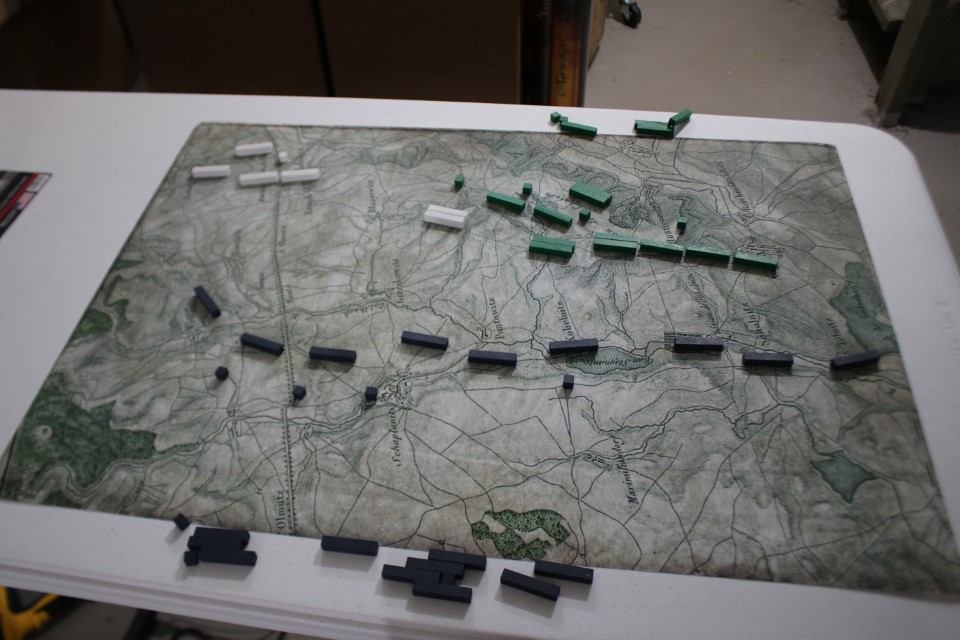
Setup: Confederate – All forces begin on the map. Set up first, anywhere 1 mounted move from the Southern Map edge and one mounted move from the Eastern map edge and North of the Hanover Road. Union – All forces begin on map. Set up within 1 infantry move of the South map edge, and within one infantry move of the East map edge, south of the Hanover road.
Victory Conditions: Meade must at least Force Lee Back (cause him to pack up a Baggage Train), or the North suffers a major defeat.
Here is a video of my first play. I always like first plays because it feels most like how the actual commanders felt. I have played the regular Scenario over a hundred times, that is very different from what Lee and Meade were facing!
I was surprised to discover just how easy it can be for Lee to win at Gettysburg on day 1, if the Union player isn’t careful. I always figured that since the battle was so fluid that first day that nobody would be deploying Baggage Trains, and capturing the enemy’s Baggage Trains is usually the quickest way to win.
Usually.
Except Gettysburg is a meeting engagement. That means that on the earliest turns the number of infantry blocks on the board is small, so that inflicting 50% casualties is easy. Let us look at the number of casualties necessary to defeat the opponent.
It can be seen that the Union actually outnumbers the Confederates on turn 3, and then the following turn this reverses. The bare numbers don’t tell the whole story. On the first two turns it is nearly impossible for the opposing infantry to meet. On turn 3 the Confederate forces will have local superiority as the Union troops lose a turn getting to the fighting. Turns four, five, and six will have the greatest chance for a Confederate victory as this situation lasts. The overwhelming Confederate forces arriving on the final two turns will be in column and not likely to participate in combat. By turn 1 of Day 2 the infantry forces will be equal, with the union having more artillery, and three fresh divisions will arrive by turn 6.
It may seem like a relatively easy scenario for Lee to win, but he has some difficulties. First off, it is very hard to actually eliminate units if your opponent is intent on conserving their strength. This is best done by avoiding even odds combats, keeping to cover, and retreating after the first round of combat, rather than fighting to the bitter end.
This also keeps the game very dynamic, as early losses by the South can see the Union player striving for an early win of their own!
Neither commander was expecting, or wanting, a battle at Gettysburg. Unacceptable early losses by either side could have led the commanders to halt the engagement, or failing that, alter the conditions enough so that the battle of Gettysburg would have been entirely different. These issues are too complex and speculative to be decided in-game. The results are best discussed over a pint at the pub.
This early victory topic comes up as my last video is an excellent demonstration of an early win. But who gets the early win?
You may have wondered about how Pub Battles could simulate leader quality. The short answer could be that they already do this with leadership ratings, but that isn’t really satisfying since all Corps leaders of an army use the same rating. Why are demonstrated leaders like Hancock rated the same as less historically successful leaders Like Lew Wallace?
I will answer that Pub Battles does address leadership quality in the same way their historical counterparts did; with superior commands. Military practice is to pair the best with the best. You don’t want to saddle your best commanders with substandard, ill trained and equipped troops. You give your best commanders the best troops to take advantage of their abilities. Likewise, you don’t want your best trained and equipped troops assigned to some ham-fisted bumble who can’t be counted on to even be ready to strike when the iron is hot!
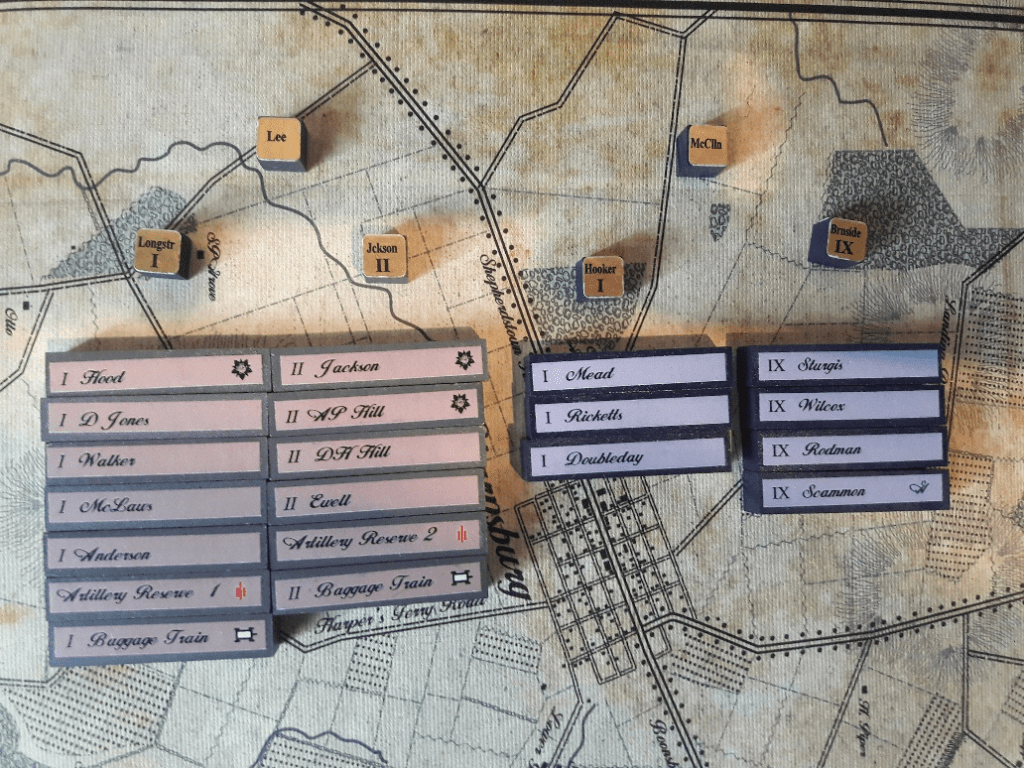
Looking at the side by side picture of each army’s top two formations at Antietam, one can readily make two observations: 1) At this point in the war, Lee had the superior army, and 2) McClellan’s most highly regarded Corps commander (Hooker) was not saddled with any green troops. This was the best he could do.
At first glance, Pub Battles with only 3 grades of unit differentiation (Elite, Regular, Green) is sometimes thought of as too simple. However, it must be remembered that Pub Battles is a Corps level command simulation, not a divisional, or lower, combat simulation. Furthermore, I will demonstrate that Pub Battles actually provides a very thorough differentiation between corps, and army’s, effectiveness.
First off, when one sees the unit names on the blocks, it is to be understood that the only purpose of the names is too add color. What the simulation really cares about is how many men and of what quality. Jackson’s Corps was experienced and very well led; 50% of his force is rated elite. Jackson’s II Corps was one tough band of brothers!
On the Union side, McClellan had much less to work with. Many of his troops had never even fired their weapons. His choice of General Officers, many political appointees, wasn’t much better. Thus, the Union army has no elite troops and the best he can do is to spread his rawest troops out among the other units. As such, almost all Corps contain a green block of troops. Hooker has the largest Corps with no Green troops, and Burnside was only able to bluster his way to a larger command with the addition of green troops.
A Word About Unit Tactics
In Pub Battles, historical tactics work best. You don’t want to face off elites vs. elites, ideally you want to send your elites against green troops. Get your opponent off balance and force his elite units into a rear guard defense.
The French Old Guard were like the terminators of the 19th century. They just kept coming. As a regular trooper they were unnerving, versus conscripts they were absolutely terrifying! The Grognards rarely got an opportunity to close because of the shock factor. Shock troops were “shock” troops because of their ability to terrify. A soon as they closed, the enemy new their time was up, so they gave in sooner. This was why Black powder era troops didn’t wear camouflage and hide, they boldly strode up. Against relatively ineffective black powder weapons, this actually saved lives. As we enter the era of modern warfare, this becomes criminally stupid.
In Pub Battles you want your elites to easily overcome the militia troops and create holes in the enemy line. If you’re attacking, you want your militia in front. They will probably not last past the first round, but they might do some damage to the enemy so that your regular troops following up can now fight at an advantage. Artillery fires first. If it gets 3 hits, it will destroy a militia or a regular unit, better its the militia. A regular combat, unit on unit with no cover or quality mods, is a 50/50 affair. To be successful in Pub Battles, just like historically, you want to primarily fight battles where the odds are on your side. Elites on elites, no. Elites on regulars, good. Elites on Militia, best!
This is my experience with Pub Battles and leadership/unit qualities. Do you agree, or have you found the proof in your pudding different?

 Pub Battles: Home Brew