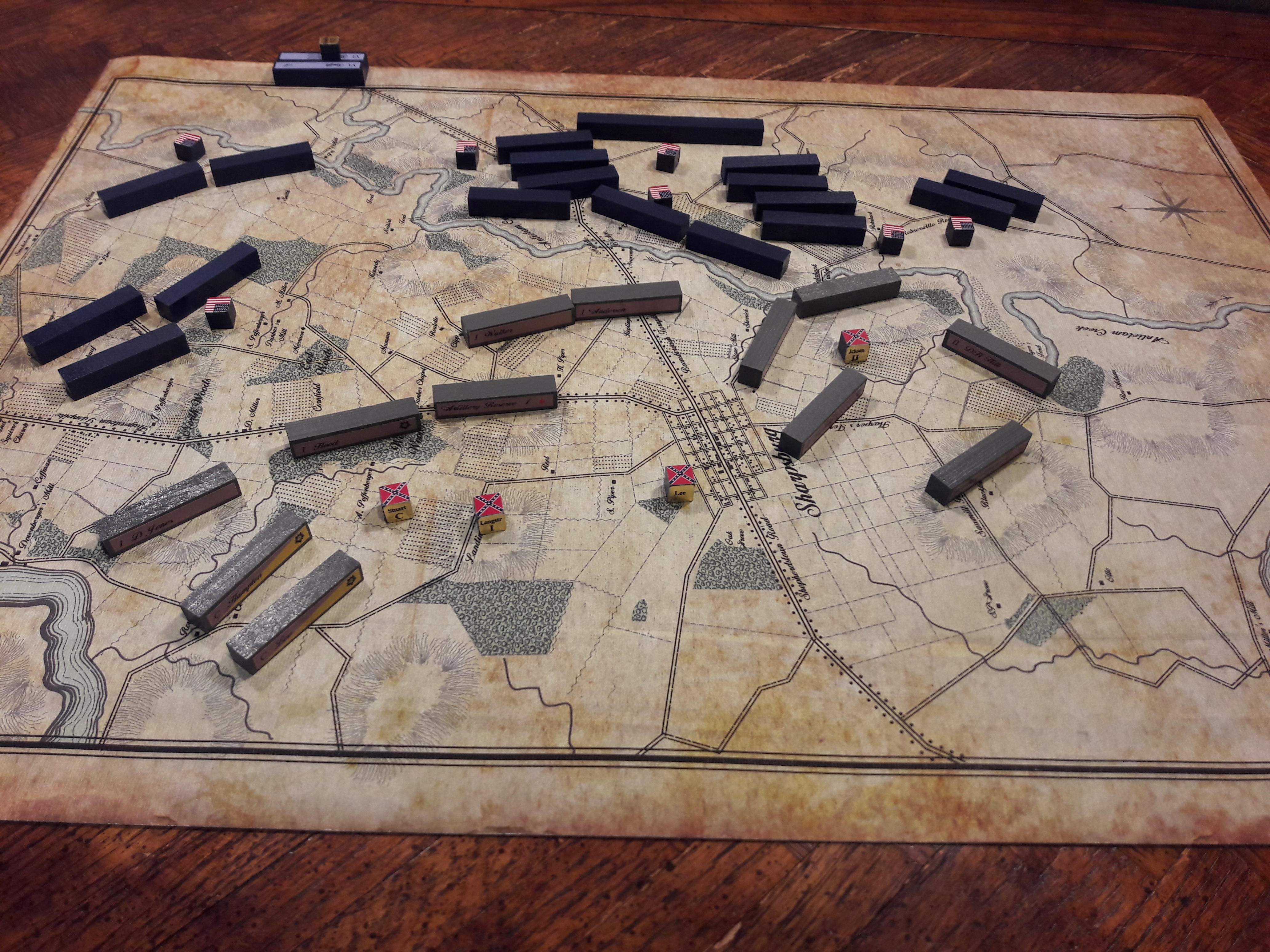
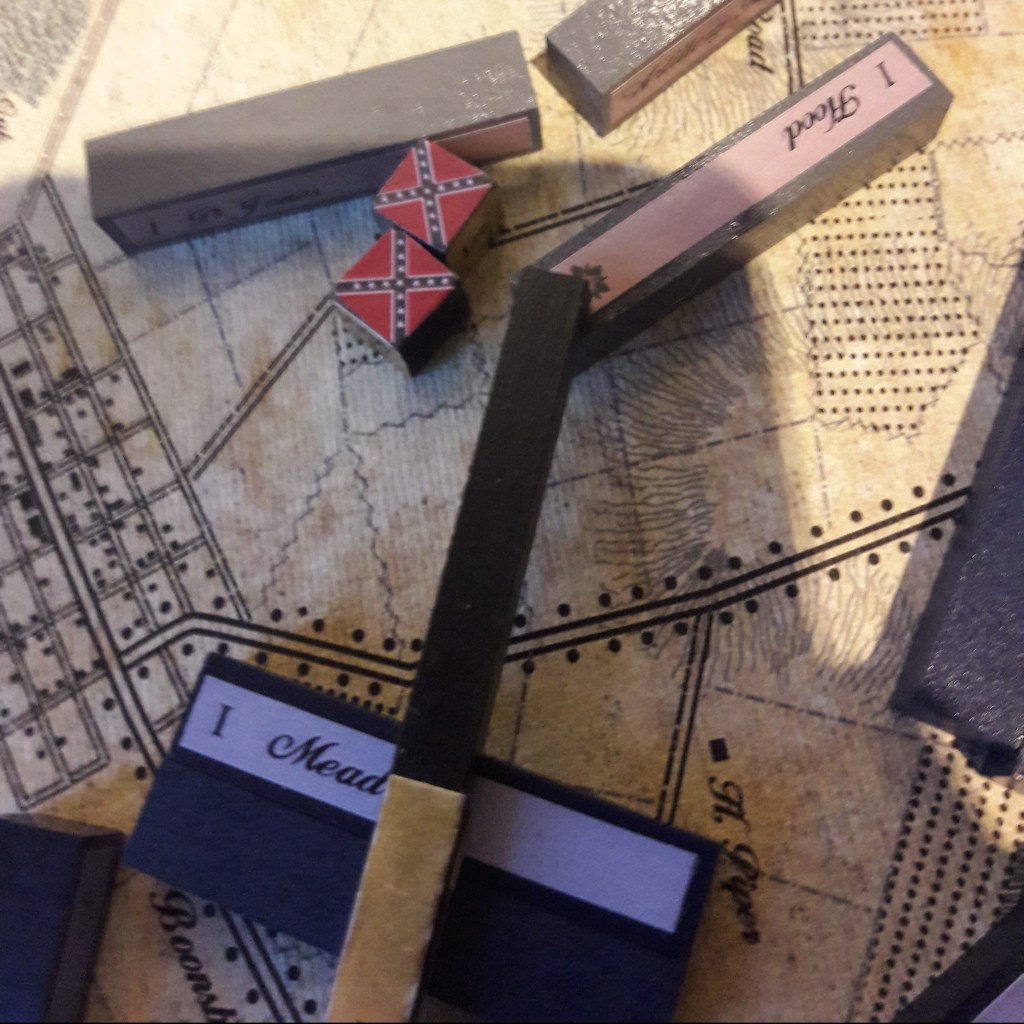
More combat rules?

In spite of the fact that Pub Battles focuses on command, many people want the combat rules more detailed and fleshed out.
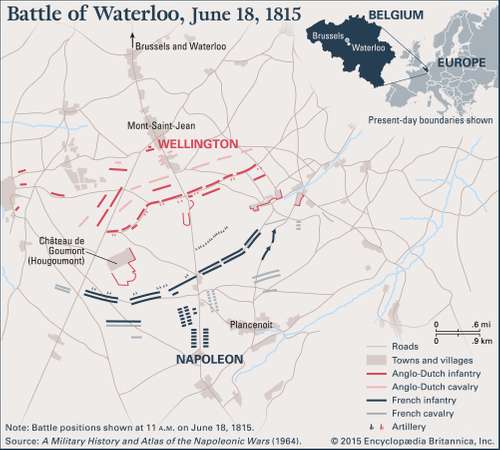
I have no question that it would work. The system is robust. My concern is that the system will lose its authentic feel. Combat decisions should be quick and direct. They should not founder on specific weapons and tactics that are the domain of lower level commands.


Pub Battles has a very simple combat results process. Any “improvement” is going to add to the complexity and force players into micromanaging their forces.


This level of detail isn’t appropriate for an army commander, that’s why he has lieutenants,  and that’s where command headaches start, because unlike a player, he can’t be everywhere on the battlefield. 
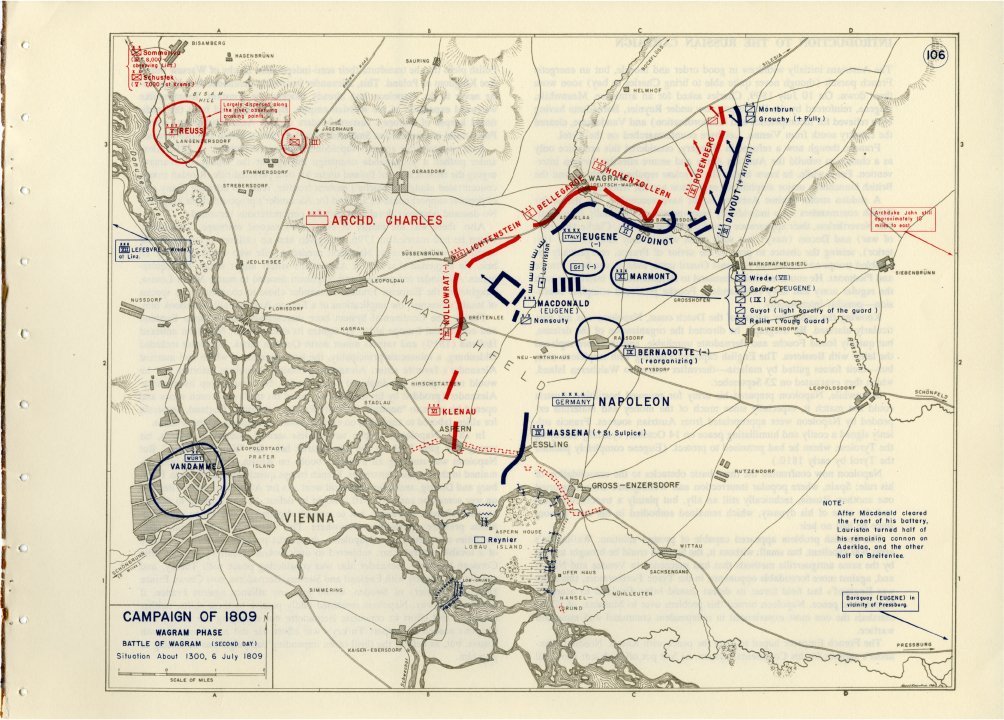

Command Post Games has the right name. Pub Battles simulates the army commander back at the command post.


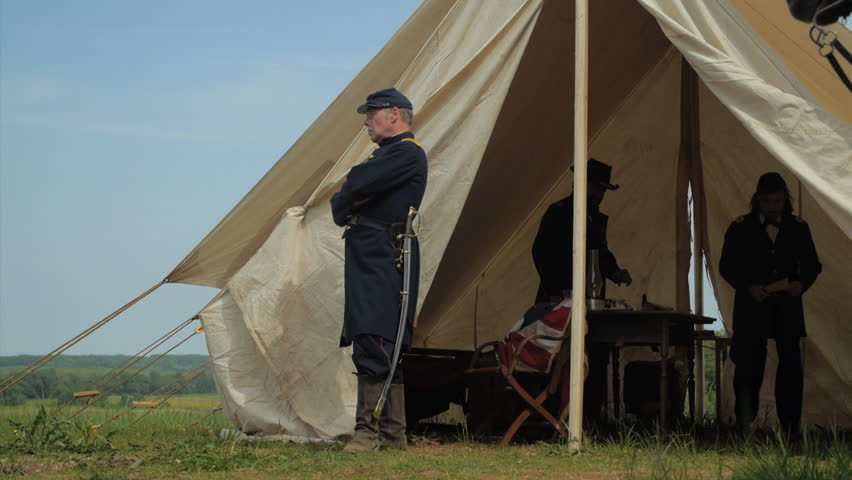
He writes his orders and an aide dashes them off to the field. He hopes that they get carried out. He hopes the info he has in front of him on his map is accurate! Will this be another case of the orders making no sense? Will the Corps commander have to confirm them, given his present situation? The clock is ticking.
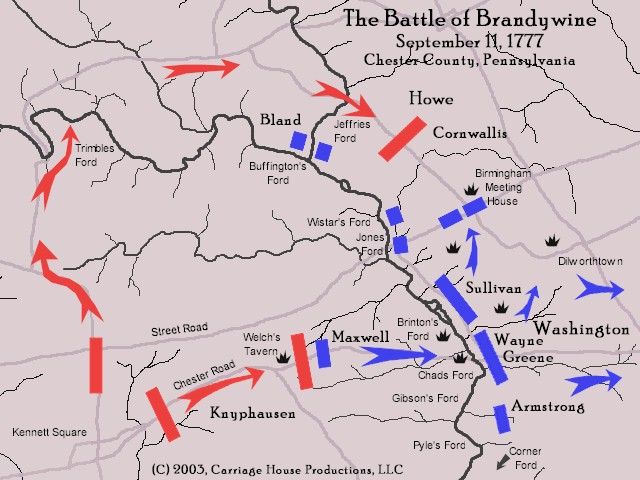

All the commander has is the best estimates of enemy (and friendly, for that matter!) strengths, conditions, and positions.


When I played Brandywine double blind with Marshall (PBs lead designer) reffing, I got a genuine feeling of the kind of command fog that he was striving for with Pub Battles. I was on pins and needles! I’d send my orders off and desperately wait to hear back. At no time was I plotting exactly how far a block could move, or exactly what angle it was facing. I just wanted to know if they ran into resistance and whether or not they overcame it, or were running away in terror.


It was after that experience that I got a real feel for what Pub Battles was capable of, and how close it came to authenticity.


I agree with Frank Chadwick when it comes to modeling command in wargames. The trick with strategic command isn’t how to bring the player closer to the action, but how to remove him from it.

To that end,  I see any rules changes which focus on combat, or on giving players more control over their units, as being counter to the best and most unique feature of the system.
How can a unit just sit there?

Many players are frustrated when they see one of their units easily within weapon range of an enemy unit and yet the game does not let them attack. Perhaps the unit in question was only a third away, moved to contact, and then the enemy went second and backed off just out of contact.

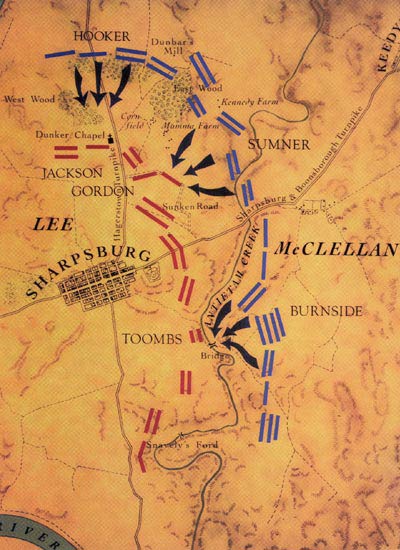
My view of what the PBs system is actually showing you is just what is shown in your command post. It is not what is actually happening on the battlefield and this is often why units that “should be engaging” are not. If they are close, they may very well be engaging, but not effectively enough to show effects at the divisional level.

This is why the chit draw may leave you feeling frustrated and stymied, when the real solution seems obvious. Yes, that’s exactly what they would do…If they understood their orders, and If they felt they were secure from other attacks, and If they are certain of the other unit’s identity, and If they are actually where you think they are, and If the enemy unit actually is there as well.


That’s a lot of ifs!


These are all frustrations that a referee will ladle out generously in a kriegspiel game, and these are the frustrations that the Pub Battles system ingeniously, and without remorse, muzzles the player’s intentions with.

What this means is that you should feel removed from the battlefield. The game wants you to face what real commanders of the time faced. They couldn’t be everywhere, so the commands were delegated to lower echelons and the commander sat in the command tent, getting reports and sending orders.

But couldn’t a real commander leave his tent and see for himself?

Yes they could, and they did. This is exactly what is happening when you flip your HQ cube and roll to Alter Turn Order! This is that seminal moment when the General steps out of the tent, climbs on his horse, and takes personal command.

Solitaire Pub Battles

This is my unofficial Home Brew version of Pub Battles. This is the way I play when it is just me. Not a true solitaire game, there is no AI, but just a way of playing when no opponent is present. Pub Battles is well suited to solitaire play as it is simple and the chit draw serves as a convenient ‘save point’ if you get called away.

One of the ways I frequently play Pub Battles solitaire is as a simulation engine. I have an idea for a different strategy or I want to try out a new rule with a familiar strategy and this let’s me “run it through” a few times. Pub Battles plays so quick and easy that this is a viable option.

Pub Battles is an amazingly robust system. I have seen many different rules tried (and mostly discarded) and the system works with them or without them.

Of course you can always add rules that factor in this or that. You can always add different combat modifiers and effects that give the game a slightly different feel. Maybe there is one thing that blocks your enjoyment of the game. Fine, add it in and have a blast.

I generally go the other direction. I try to eliminate every rule that isn’t absolutely necessary. I find this speeds up the game. The whole point of the rules is to focus on command interaction, and simplify and gloss over combat detail. This is the main reason I developed a single die per side combat system. It’s quicker and easier. Not a huge difference, I am happy to play “the right way” when playing in public or introducing new players to the game.

The really cool thing I find about this is that by not specifically trying to model one thing, the system models everything in general. So let’s dig into my version. I’ll add my designer’s notes in italics.

All official Pub Battles rules are in play, except as modified below:

Alter Turn Order – For the most part, when I play solitaire, I just deal with the chits as they are drawn. This forces me to learn to roll with fate. As a consequence, I rarely try to Alter Turn Order when playing versus a live opponent!

Combat

  • Developer’s Notes

I don’t care for Field of Engagement. I find it time consuming and inelegant. No unit is ever necessarily just sitting, they are always in motion. Their fluid movement is chopped up by the arbitrary turns that are superimposed over the battle simulation. In addition, there are plenty of incidents where a unit did not do what it should have done, maybe they didn’t recognize the identity of the unit, maybe they were confused about there orders, maybe a regiment got lost, or the commander just had cold feet. All the game shows are those combats that actually were executed to the extent that resulted in an entire division suffering some sort of dramatic effect. Also, all you are really seeing is your best intelligence as regards the unit’s position. Maybe it’s not attacking because its not precisely there! Hopefully, your next orders will make sense for them to follow (or will they have to write for clarification?). The system doesn’t attempt to tell you precisely why a unit did or didn’t follow your orders, it merely shows what happened.

Field of Engagement doesn’t allow for implied combat. Nearby units may be exchanging shots and the pickets or skirmish troops may even be engaging in some very hot exchanges, but nothing that results in the parent divisions being adversely affected to the extent modeled in Pub Battles.

Flanking by merely having a single unit attack along the side of a block is gamey in the sense that it takes advantage of the wooden block’s inability to curve and deny a flank the way actual formations did.

The Cost!!!

Many folks look at the cost of Pub Battles games and complain that they are just too expensive, especially for a game that is so easy to play! Maybe if it were buried under an impenetrable 100 page rule book and had lots of charts and tables and was completely unplayable…

I don’t mind paying a lot for a game that I play a lot. Especially, if it has truly beautiful components. FYI – I own every pub battles title and I paid full price for them. In case you’re thinking that I get them for free because I’m a play tester.

It is important to note that the price people are complaining about is the top end fully loaded Cadillac version of the game with all the bells and whistles, including the canvas map. It is possible to get a perfectly fine copy of the game with a paper map (nice Quality) and you will have to make your own measuring sticks (a template is included). You still get wooden pieces. You can get Brandywine for $62.66, and Antietam and Marengo for a little more. Even Gettysburg can be had for as little as $83.25.

If that’s not cheap enough, you have a chance to get the games for free if you send Command Post Games a picture showing you playing a game in public (you will have to buy the first game). Check their website for details.

The only drawback to buying a paper map is that it is not as durable as a canvas map. I play these games at bars pubs and they get spilled on, set on messy tables, you name it. The canvas wipes clean. I have several games that I have played over a hundred times and the maps still look brand new!

I realize that at over $50 these games are expensive. Too expensive to just throw your hard earned money at on a whim. I hope that after reading a few of my introductory posts you might be inclined to take the plunge and try one out!

Play the Map! What makes Pub Battles The Best Game System?

I have been wargaming for over 40 years. Many times I would look at a military atlas with its maps showing bars for units and wondered, “Why doesn’t anyone make a game that looks like this? I want to play the map!”


Many games came close, but then they buried you in rules. I was never afraid of rules; heck, I played Advanced Squad Leader for years! The problem was, I had this very definite picture of what playing the ideal wargame would be like. I pictured two players at a wooden table with high back leathern chairs, sipping wine from glasses and peering over a canvas map with wooden blocks. And that was it. No charts and tables scattered about. Just the map and the troops. It may have been a dream, and not a very realistic one, but it was my dream.

As I have played wargames over the years, I have always hungered for that authentic experience. So many games that want to be more realistic try to accomplish this by being more complicated. The rules become a barrier between you the player, and you the General. I had assumed this was how it had to be.

Then came the day I saw Command Post Games’ “Brandywine” on Kickstarter and my heart almost stopped. Here it was! Canvas map and Wooden blocks combined with a simple fast playing system. It wasn’t until I received my copy and read the rules that I saw the potential for a really authentic system.

You see, I had been studying assymetrical post-modernism in literature. It was at the right time for me to appreciate the genius of the chit draw mechanic and the simultaneous movement that it captured. I had just written a paper on the ordering of near simultaneous events in a linear story. This is exactly what the chit draw mechanic accomplished. It wasn’t just a way to move, but a way to sort out a million delays and coincidences, small skirmishes and lost orders, any of the myriad of happenstances that can occur in any given 90 minute turn.

I had found my game.

Play the Map!

Rules Questions

Here is where you can ask me any rules questions regarding any Pub Battles games. If I don’t know the answer, I will communicate with the design team and get back to you. I have been around since the first title “Brandywine” was made available to the public.

My Context on what Pub Battles is

When you play a wargame and are expecting an authentic experience, you must know the intent of the designer. Pub Battles was designed with the intent of creating a two player Kriegspiel experience. In a refereed Kriegspiel game, the many players write orders which the referees then interpret on the battle field. They then report to the players some version of what happened. Kriegspiel is very fun, but takes a long time to organize.

Pub Battles was created with the intent that two players could sit down and play a quick and fun game. The focus would be on command, and combat would be a simplified extension of that. Of course, no one can leave a simple system alone and there have come many suggested additions to the rules to make them more realistic.

While many of these rules have been fine, I’ve yet to feel that they improved the game, they just made it different. In response to the increase in rules volume, I have created my own homebrew version. Unlike many home brew version of games, my “brew” focuses on how few rules are really necessary.

My view of what the game is simulating is this:

When you move a piece on the map this does not mean that the unit is literally moving exactly like that, this is equivalent to writing orders to that effect and sending them off via an aide de camp. After the combat phase is complete you see the map after other aides have received reports from the field and scrambled to translate these into a coherent diagram of the battle.

This should leave you feeling a little removed from the action! Gone is the godlike feeling of moving armies around like marionettes, with perfect knowledge of yours and the enemy’s positions and strengths. In this way, Pub Battles comes much closer to feeling authentic than any other game system, no matter how many pages of rules they use.

In fact, I see rules as coming between you and the authentic experience you desire. After a few games of Pub Battles you probably won’t even notice the rules. There are no combat charts, movement is simple. Once battle is joined you may find yourself rarely even using the movement measuring sticks. It’s that good.

And yet, what rules there are have a profound effect. Militia is almost useless, you hate to have to rely on them. The all too rare elite units can seem very intimidating. Many of the scenarios have special rules for just those battles or periods that provide a very unique feel.

When you feel that you have a good idea for a rule (sometimes I have so many I can hardly play a game without stopping everything to try one out) it is a good idea to ask yourself if the game works fine without it. Using this culling technique I have never added a rule, unless it was to make something even simpler.

There are many times when what you see on the map does not make sense, or look quite right. Usually, this is because two opposing units seem close but are completely ignoring each other. Remember, the unit’s actual positions may be different than the approximations that you have before you on the map in the command post. There are limitless reasons why they may not be in combat, one of which may be that they aren’t really there! Remember, the black powder era was a long way from our current GPS calibrated maps. I bet modern commanders still feel out of touch with what is really going on with a modern battlefield. Not to mention counter-intelligence efforts.

Pub Battles: Homebrew

A playtester’s guide to enjoying the Pub Battles System. I am not part of the company beyond playtesting, but I am here to answer any questions about the official rules as well. To order the games go to the Command Post Games website:

If you want to get one of these beautiful games: Click this. 

If your curious about the system here’s an overview.

If you are new, here’s my quick start rules

My current homebrew rules are here.

My rules discussions are here: Movement rates  How can a unit just sit there?   When to Alter Turn Order   More combat rules?    Chit Draw

My Variants are here: Night Rally   Optional Leadership  Baggage Trains  Solitaire with Written Orders    

Gettysburg posts: Stonewall at Gettysburg   

Waterloo posts: 3.0 has rendered my Waterloo post unnecessary and it has been removed.

Play the Map!