Marshall Barrington, the system’s designer, has been reviewing the original Kriegspiel rules for his new book on Kriegspiel for modern audiences.
Although Pub Battles emulates Kriegspiel, it does not mirror it. Pub Battles creates a way to play Kriegspiel without an umpire, and focuses even more on command. Most of the Kriegspiel rules are a GM’s guide to running a Kriegspiel battle. Playing Kriegspiel is fun and easy. Running Kriegspiel is daunting.
However, Marshall has garnered some nuggets of wisdom from the original designers of Kriegspiel, things about how combat really went down on a 19 century battlefield. They fought in the Napoleonic era, they didn’t have to rely on other’s accounts.
There are many things that Pub Battles glosses over because the blocks represent divisions. In a sense, it is most accurate to compare Pub Battles to a divisional hex and counter wargame. The blocks tend to make one think of regimental level units, but that is inaccurate! The labels on the blocks tend to make one assume that is the exact unit represented, that is also inaccurate. The labels add color and drama, but that is all. Each block represents between 1000+ to 7000+ men (half that for cavalry). That’s a lot of wiggle room! When designing a Pub Battles scenario, the critical issue is what feels right, not what exactly is there.
Cavalry has never felt quite right to me. Cavalry was to 19th century armies what armor was to WWII armies, but it didn’t feel that way in Pub Battles. With all that in mind, these rules are under consideration:
Any block may retreat before the first round of combat from an infantry block without becoming spent.
2. Foot (infantry or artillery) that is required to retreat from Mounted is eliminated instead.
3. Artillery rule that was here has been discarded.
Note that dragoons can/will be handled differently. As with any cavalry rules, you always want to read scenario special rules.
As always, the focus is on keeping Pub Battles a fast playing, smooth, command focused, simulation.
Marshall Barrington, the Pub Battle system’s designer, was studying the Kriegspiel rules, and came up with a variation for resolving Pub Battles Combat. Rather than becoming spent on the first hit, a block retreats. With a second hit it is reduced to spent. All this means is that the hit process is reversed; Retreat then spent, instead of spent then retreat. If a fresh unit retreats, it maintains its facing.
This is a relatively subtle change, and yet it can have profound effects. The Baggage Train rules make becoming spent more of an issue, because the unit doesn’t automatically rally, it now needs an unpacked Baggage Train.
After giving it some thought, I decided it would be more interesting to let players decide whether or not the unit would hold or retreat. So, when you receive a hit you decide whether to hold your ground and become spent, or to voluntarily retreat in good order.
A key concept at this point is the voluntary retreat, which I will call “Fall Back.” The difference is that if you retreat, you turn 180 degrees and face the other way. If you Fall Back, you retreat, but maintain your same facing.
One additional rule I want to add, is that if you have been contacted by the enemy prior to your chit being drawn, you must either remain in combat (you can turn to face), or Fall Back. You can no longer move any way you want. The reason being, if you are there to block the enemy’s movement, then you are affecting them, which means you must have been there when they moved. You are still preventing them from moving, and you are successfully Falling Back (fighting retreat) without them forcing a decisive combat.
In this case, moving after your opponent can be thought of as having the command initiative. You have anticipated your opponent’s intentions. The combat is occurring on your terms.
Experimental Rule: First Hit
Definitions: Retreat: Involuntary movement from combat, if fresh, become spent, and turn around moving 1/3 away from enemy. Fall Back: Voluntary movement from combat, maintain facing and move 1/3 from enemy.
If you are in contact with an enemy block when your chit is drawn, you must either remain in contact, or Fall Back.
A fresh block that receives only one hit in combat must flip to spent and remain in place, or Fall Back. If fresh, don’t become spent. If spent, You must Fall Back, but maintain facing.
A fresh block that receives receive two hits must Retreat and becomes spent. A spent block that receives two hits is eliminated.
Movement before combat: Any fresh unit may Retreat before combat, except fresh Dragoons in contact with infantry, may Fall Back.
I am going to try these rules in my next game. One of my purposes in writing this blog is to put all my thoughts in writing. I intend to find out if it is too fiddley to be worth the effort, or if it makes for a better experience.
Baggage Trains mean more than just food and bullets in Pub Battles.
I want to increase the importance of Baggage Trains in Pub Battles and give added reasons for wanting to unpack them. They mean more than just a depot for supplies, they are the entire logistical network that supports an army in the field.
In addition for being necessary to rally spent units, I want to add the concept of them being critical for an army’s ability to recover from protracted combat. Let’s replace the 50% night turn recovery rule with this:
During a night turn an army may recover two blocks for each unpacked Baggage Train.
This means that a player can take stock of the situation at the end of the day, and during the night turn decide to unpack Baggage Trains in order to recover more units.
I tried the variant in my recent post https://pubbattleshomebrew.blog/2021/07/17/field-of-fire-review-with-solution/ and quickly found it wanting. 1/3 is just too much! That is basically a half mile away, and forcing troops a half mile away to fight, with muskets that aren’t effective at much beyond 50′, seems a little silly. Then again, determined troops that are trying to reach an enemy aren’t going to stop 2/3 of the way there! If a block can move its full move and fight x rounds of combat, then a determined attacker should be able to follow through and make the attack if within a third.
Here is what I am going to try next:
A unit that finishes its movement within 1/3 of an enemy unit may be moved to contact, if it finishes its move within one base thickness (3/8″) it must be moved to contact.
Stay tuned for my next video and we shall see how this plays out!
In this variant I reorganize the Coalition army into 3 large Corps. Like many strategies in Pub Battles, there is no “best” way to do something. Large or small Corps have their advantages and disadvantages. Large Corps are great for concentrating a lot of forces on a narrow front for an assault, but can be challenging if trying to react with any precision. They tend to be big hammers. On the defensive, where combat command isn’t so crucial, they can be quite adequate.
(DISCLAIMER) Pub Battles Austerlitz is an excellent game as is. This variant is only presented as an alternative that highlights the flexibility of the system.
Smaller commands can make mounting an effective attack difficult, but can make for a more flexible defense.
The big factor to consider is your Leadership rating. The French (or the Confederacy), with a 4 rating, can usually make their Alter Turn Order rolls, and gain both flexibility in concentrating their efforts, and in reacting to enemy actions. On the other hand, the Coalition (or the Union), with a rating of 2 (or 3), can have a very tough time.
For this variant, while I allow the Coalition player to reorganize their army, it comes with a limit. The original Corps can’t be broken up, only combined with others. This is because of the intermixing of troop quality. In most armies, the lower quality troops were intermixed with higher quality troops. The regiments tended to be of one quality, but different regiments would then form higher level organizations. A Corps may be comprised of 50% conscripts, but those battalions would be spread around. In pub Battles, that is shown when half the blocks of the Corps are militia. The Corps with 50% militia is less effective than one without, so it works at the Corps level. Remember that the names on the blocks are given for color, not because that division was actually all conscripts (or elite!).
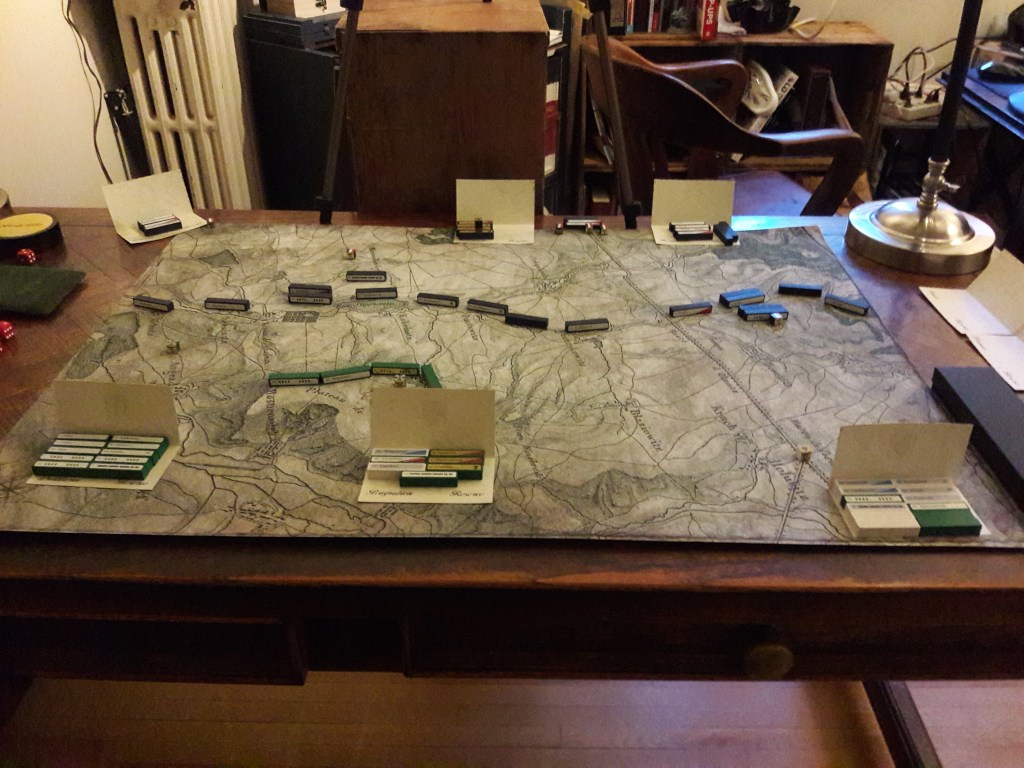
In the foto above, I only intend on attacking with Docturov’s Corps (on the left), but to disguise my intentions I have my army organized into 3 large Corps. This disguises my intent, and is very unnerving to the French player as he sees three large threats to contend with. Which one does he prepare for?
Because the French begin with over half their army off board, this gives the Coalition player a slight edge in the early turns. If they can do enough damage early on, the French may never recover. If they decide to remain on the defensive, the French can chip away at their less adaptable army and where them down while watching for an opportunity to administer that “one final blow.” Either strategy is viable, and either can be countered.
War is uncertain. Sometimes, using the above setup and strategy of having Docturov attack the French right, will see all his attacks thrown back, other times will seem him sweep the stretched French defenses, most times it will be a combination. Every game will play out differently. Often the chit draw will serve to compliment or confound your plan! You must have a plan, and yet be flexible.
Austerlitz out of the tube works great. This variant isn’t to “fix” something, but is actually a variant. A “What If.” I have played the regular version over a dozen times, and I want to try something a little different.
What if Napoleon felt that the Coalition wasn’t buying his charade that he was weak. So he starts all in. Davout still doesn’t make it from Vienna until turn 2, but other than that, all French forces start on the map.
There are occasions where both sides are better off defending and making their opponents attack. Austerlitz is one such battle, hence Napoleon’s deception. If the deception, which was daring and not sure of working, had not been successful, then actually attacking would have been necessary. How to make the French attack a larger foe?
To answer this, I have created the concept of Bridgeheads. Not actual bridgeheads, but close enough to make for an adequate label. In addition to the other two ways of winning, routing the enemy, or capturing their Baggage Trains, let us introduce a third way.
By scenario definition, a bridgehead is created when you are the first player to unpack a Baggage Train in a designated enemy area. At the end of the game, if the Bridgehead has not been destroyed by the enemy, you win!
Unlike when a regular Baggage Train is unpacked, when a Bridgehead is created, the label is exposed and the enemy is made aware of the Bridgehead. Only one Bridgehead can be created per game. Deciding when can be critical. Too soon, and the enemy has time to destroy it, too late, and the enemy may deploy it first!
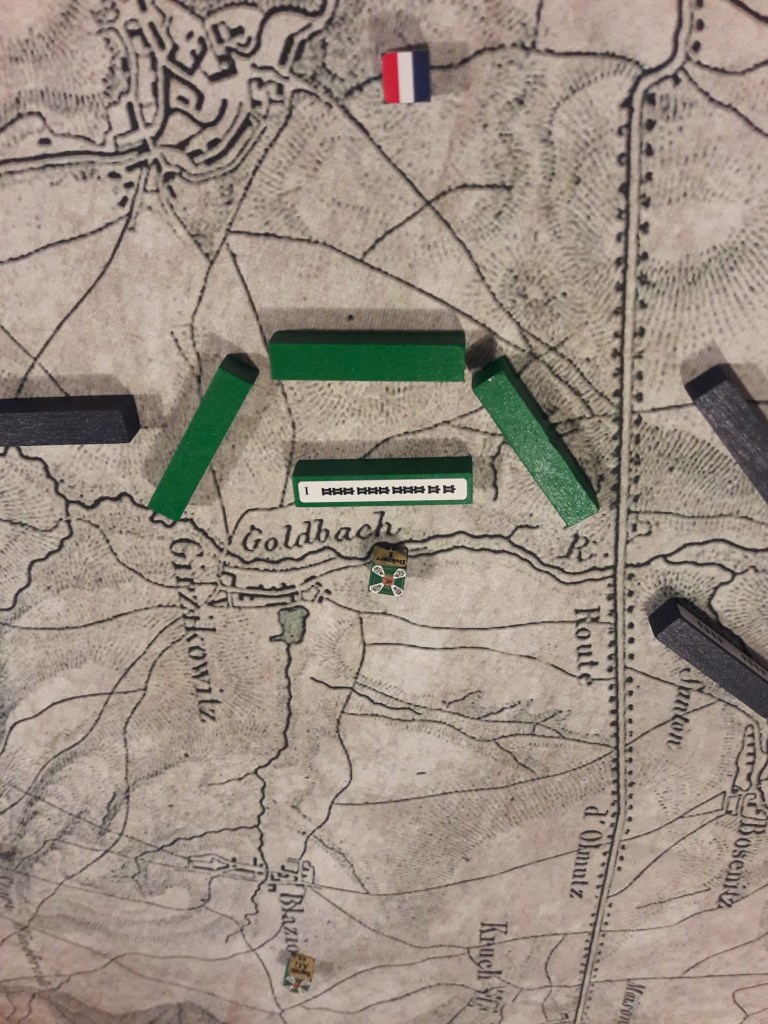
For Austerlitz, The coalition needs to Build a bridgehead across the Goldbach (i.e. the west side), and the French must build one in the town of Pratzen.
This blog will be updated from time to time as I find smoother and cleaner ways to play Pub Battles.
I am happy to play with the tried and true “official” rules. Pub Battles is quite a robust system and you can add all kinds of rules. These can be fun or satisfying, but most are unnecessary. I am very leery of adding any rules, other than those that smooth or speed play, as the system can quickly bog down. Remember, Pub Battles is first and foremost a command simulation, not a combat simulation. Most of these rules add some time if you incorporate them. Consider them very optional!
Title in bold. Rule is normal font. Discussion/clarification in italics.
Cavalry – Foot retreating from mounted are eliminated.
It just feels wrong to resolve a round of combat, mounted charging foot, and then have the foot pull back while the cav just stands there!Note: this isn’t talking about the chit draw (movement phase), but actual combat!
Artillery – Spent Artillery may fire.
Originally, pre Baggage Train Rally rule, blocks just rallied from spent automatically if they didn’t move. So the proscription from bombardment felt right. Now, with an unpacked Baggage Train required to rally, it is too harsh. If you don’t rally your artillery, it is still very vulnerable, just not nearly useless!Instead of being a new rule, this is just eliminating an old rule!
One Hit on Fresh Block — A fresh block that suffers one hit may either, flip to spent, or fall back Fresh.
Of course, Militia do not have this option.
Support – Supporting blocks may choose to suffer any of the hits of the unit they are supporting.
This makes more sense when Infantry are guarding Artillery, or if you imagine the two defending blocks half as wide and double deep. You can also imagine elite troops or Grenadier Regiments, “stiffening” the line by ignoring the first hit.
Artillery cannot support in combat, but if it is moved into a supporting position it may swap positions with a block that can support it.
This makes it possible to add Artillery to the line without requiring extra turns to get the right chit draw to allow one block to move forward while the other moves back, which isn’t what is literally being simulated anyway!
Woods —
Define defender as the block being attacked. Both blocks in combat would be defenders, in turn.
1) A block in woods cannot recover from spent.
2) Command range does not extend beyond LOS in woods.
Although Corps commanders did not need to be present in woods, having forces operate in woods, out of sight, was a drain overall on command resources, hence the need for close presence in heavy woods for offensive operations.
Detachments—
Detachments don’t flip other blocks when they retreat through them.
This rule will become part of the official rules whenever the next version comes out.
In furthering the role of detachments as light troops, I am currently experimenting with them being able to retreat from other foot troops before the first round of combat as having the same capability as dragoons
The role of detachments has expanded from FoW, to simulating the presence of light troops as skirmishers and screens.
Combining HQs and Baggage Trains
This is very experimental. Baggage Trains are no longer used, but every Corps, in effect, now has a Baggage Train.
HQs are moved first, any block within command range of its HQ (or the Army HQ) after its movement, may attack an enemy, or Rally.
If the Army HQ is eliminated, no Blocks may rally.
All HQs are recovered during a night turn, HQs may not rally blocks the turn they are recovered.
It is important with this rule to decouple one’s notion that the HQ represents the actual officers themselves! The HQ block represents the entire command and logistics nexus for the Corps. Even when eliminated, the actual command cadre still exists in some form, although key officers may have been lost.
I have found that I don’t care for any written orders rules when playing Pub Battles. I find they sound cooler than they end up being. When I play solo, I use my own judgement based on how the situation looks to the HQ in question. I find this “narrative dependent technique” is more satisfying.

 Pub Battles: Home Brew