New Rules on the discussion board (in playtesting)

Marshall Barrington, the system’s designer, has been reviewing the original Kriegspiel rules for his new book on Kriegspiel for modern audiences.

Although Pub Battles emulates Kriegspiel, it does not mirror it. Pub Battles creates a way to play Kriegspiel without an umpire, and focuses even more on command. Most of the Kriegspiel rules are a GM’s guide to running a Kriegspiel battle. Playing Kriegspiel is fun and easy. Running Kriegspiel is daunting.

However, Marshall has garnered some nuggets of wisdom from the original designers of Kriegspiel, things about how combat really went down on a 19 century battlefield. They fought in the Napoleonic era, they didn’t have to rely on other’s accounts.

There are many things that Pub Battles glosses over because the blocks represent divisions. In a sense, it is most accurate to compare Pub Battles to a divisional hex and counter wargame. The blocks tend to make one think of regimental level units, but that is inaccurate! The labels on the blocks tend to make one assume that is the exact unit represented, that is also inaccurate. The labels add color and drama, but that is all. Each block represents between 1000+ to 7000+ men (half that for cavalry). That’s a lot of wiggle room! When designing a Pub Battles scenario, the critical issue is what feels right, not what exactly is there.

Cavalry has never felt quite right to me. Cavalry was to 19th century armies what armor was to WWII armies, but it didn’t feel that way in Pub Battles. With all that in mind, these rules are under consideration:

  1. Any block may retreat before the first round of combat from an infantry block without becoming spent.

2. Foot (infantry or artillery) that is required to retreat from Mounted is eliminated instead.

3. Artillery rule that was here has been discarded.

Note that dragoons can/will be handled differently. As with any cavalry rules, you always want to read scenario special rules.

As always, the focus is on keeping Pub Battles a fast playing, smooth, command focused, simulation.
Gettysburg17

Gettysburg comes alive! This is my latest attempt at providing the most interesting replay of a Pub Battles scenario. I am working on adding text to match my description, in order to make the whole video more approachable. I try a few different things on day 1 and by day 2 I settle into a more consistent style.

Do you like this way, or would you like something different?

https://youtu.be/_hcIg5TSsyE

1 Hit Wonders: Experimental Pub Battles

Marshall Barrington, the Pub Battle system’s designer, was studying the Kriegspiel rules, and came up with a variation for resolving Pub Battles Combat. Rather than becoming spent on the first hit, a block retreats. With a second hit it is reduced to spent. All this means is that the hit process is reversed; Retreat then spent, instead of spent then retreat. If a fresh unit retreats, it maintains its facing.

This is a relatively subtle change, and yet it can have profound effects. The Baggage Train rules make becoming spent more of an issue, because the unit doesn’t automatically rally, it now needs an unpacked Baggage Train.

After giving it some thought, I decided it would be more interesting to let players decide whether or not the unit would hold or retreat. So, when you receive a hit you decide whether to hold your ground and become spent, or to voluntarily retreat in good order.

A key concept at this point is the voluntary retreat, which I will call “Fall Back.” The difference is that if you retreat, you turn 180 degrees and face the other way. If you Fall Back, you retreat, but maintain your same facing.

One additional rule I want to add, is that if you have been contacted by the enemy prior to your chit being drawn, you must either remain in combat (you can turn to face), or Fall Back. You can no longer move any way you want. The reason being, if you are there to block the enemy’s movement, then you are affecting them, which means you must have been there when they moved. You are still preventing them from moving, and you are successfully Falling Back (fighting retreat) without them forcing a decisive combat.

In this case, moving after your opponent can be thought of as having the command initiative. You have anticipated your opponent’s intentions. The combat is occurring on your terms.

Experimental Rule: First Hit

Definitions:
Retreat: Involuntary movement from combat, if fresh, become spent, and turn around moving 1/3 away from enemy.
Fall Back: Voluntary movement from combat, maintain facing and move 1/3 from enemy.

If you are in contact with an enemy block when your chit is drawn, you must either remain in contact, or Fall Back.

A fresh block that receives only one hit in combat must flip to spent and remain in place, or Fall Back. If fresh, don’t become spent. If spent, You must Fall Back, but maintain facing.

A fresh block that receives receive two hits must Retreat and becomes spent. A spent block that receives two hits is eliminated.

Movement before combat:
Any fresh unit may Retreat before combat, except fresh Dragoons in contact with infantry, may Fall Back.

I am going to try these rules in my next game. One of my purposes in writing this blog is to put all my thoughts in writing. I intend to find out if it is too fiddley to be worth the effort, or if it makes for a better experience.

What do you think of this new rule?

A Prepared Defense

A “Prepared Defense” showing the increased range coverage.

On a very rare occasion, a rule makes it past my “Does the game work with out it?” litmus test question. One way it can slip past this net is if it is simple, fun, and leads to a better “feel.” The Baggage Train rules did that in a big way.

Now I’m thinking of including the Prepared Defense rule, wherein a player, by scenario definition, may begin with bags unpacked. The advantage is that the rally range is doubled to 2/3 of a mounted move. The disadvantage is, you pretty much are drawing a line in the sand and saying “We will hold here!” No chance to give ground if the chit draw does not favor it.

The rationale behind the doubling of the rally range is that it implies a more planned and laid out defense, where supply routes and staging areas have had time to be developed more properly.

I like this rule for two reasons. The first is that it is almost effortless to include. One need only remember to double the range to rally. The second is it adds a nuanced level of strategy. The kind of thing a new player may have difficulties with, compared to a more experienced player. Not because it’s complex, but because trying to judge where to place the Unpacked Baggage Train is an important decision that relies on a deft touch and feeling for the game. A rule that rewards experience, not rules lawyering.

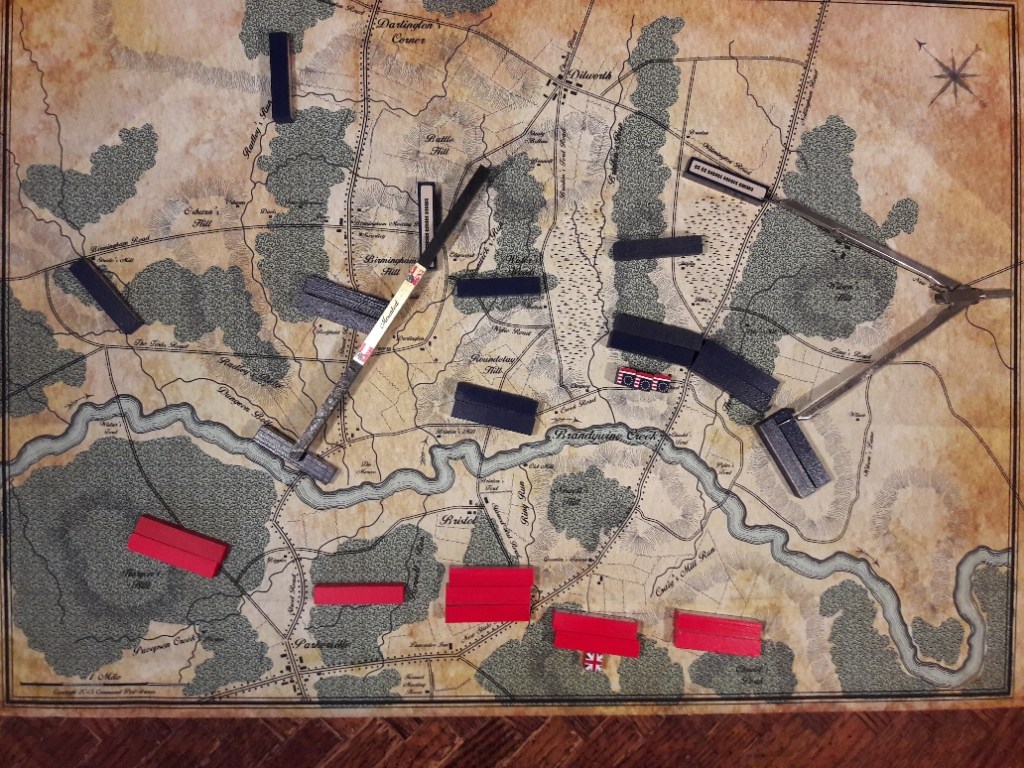
In my first game testing it, which you can see here, Washington began with a fortified Brandywine line. It worked this time, meaning it helped. I wouldn’t say it was why the British were held at bay, but it didn’t hurt. I can’t wait to try this out at Waterloo!

I’m going to continue to play test this in appropriate scenarios.

The Corps, in Pub Battles

Pub Battles is a command focused system, as opposed to a combat focused system. This doesn’t mean combat isn’t important. It means that a lot of the details of combat are left out. When the composition of a Corps is being constructed, effectiveness as a unit is prioritized over the details of specific unit composition.

When designing a Pub Battles scenario, one can first divide the individual Army’s total manpower by 4,000 to get a rough idea of how many blocks to include. This is just the starting point. Then one must consider cavalry and artillery, and how it acted in the battle. How many blocks, if any, give the right feel? Then there is efficiency. If the units had exceptional leadership and troops, it might be appropriate to include an elite block. If there were a significant portion of green or hastily raised troops, then some militia might be in order.

When all that is done, the OBs are then extensively play-tested. How do they feel? Can they duplicate historical behavior. Maybe a block is added here, or taken away there. Maybe an elite is added/subtracted, ditto with militia.

The very last thing that is done is the naming of the blocks. The unit ID is purely added for color. Without them, the game feels lifeless and generic. With them, the game feels more real, more fun.

When a corps is in combat and one of the blocks is eliminated, say Hood’s Texans at Antietam, it does not mean that the Texan division has been lost (though it might), What it really shows is that the effectiveness of the Corps has been reduced to the point that it is no longer accurately modeled with an elite block.

Of course, it is much more fun to simply think that the last of Jackson’s stalwarts has fallen! No harm, no foul.

Baggage Trains

This is very true with Baggage Trains. What does a Baggage Train represent? It may represent actual bags, hospitals, reserves, etc. All that is known is that if the enemy reaches that point, it’s game over. In actual terms it’s that point where a force is broken, either the troop’s, or the commander’s, will to fight is gone. Every decisive combat has had that point. The trouble in game design is that it must be quantified.

The Baggage Train rule is that mechanic. It takes a hazy uncertain point, a point that only those in the moment can sense, and models it in the game. It is literally vague, so that it can be figuratively exact. That is elegant design.