Playing Solitaire

I find Pub Battles uniquely suited for playing alone. Note, it is not a “Solitaire game” per se. It does lend itself quite readily to playing sans opponent, however.

The rules are fairly simple and intuitive, so you’re not trying to keep all kinds of details in your head, nor referring to endless charts.

The chit draw mechanic lends itself to a “quick save” option if you have to leave quickly to handle some Real Life event.

The game plays so smoothly that it is possible to play out many what if scenarios. Command Post games even gives you all the participants in the Waterloo campaign so you can try out different possibilities for who might have made it when to Waterloo. They provide you with an alternative “What if Jackson had survived” scenario that lets you fight Gettysburg as if Lee had his “Stonewall” beside him! Of course, you can always start with Stuart appearing right away.

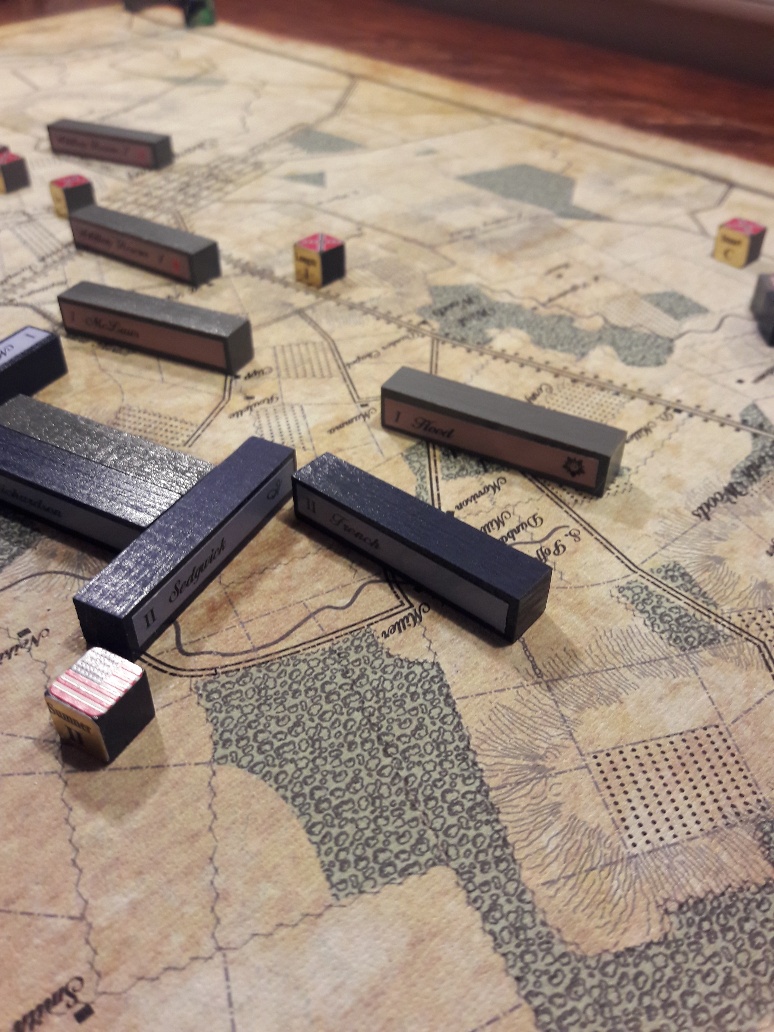
Finally, whenever I play alone, I orient the map so one side is facing me, and then I turn the other side’s pieces around so that I can easily see who they are even while fresh.

The Chit Draw

If you view the chit draw mechanic as simply a way to simulate simultaneous movement, then you are selling it short. It is a powerful mechanic that simulates the full range of events that can occur on the battlefield.

For instance, say you are playing Gettysburg and you have unguarded artillery on Cemetery Hill. Furthermore, A.P.Hill’s Chit has just been drawn and he is poised to attack with two divisions, these will sweep the hill and leave the Union line compromised! Hancock is nearby and you roll to Alter Turn Order: Success! You move first and reinforce the hill with the nearest division, the line is saved.

“Okay,” you say, “but what really happened?” What has Pub Battles just simulated? Historically, that exact situation was occurring and Hancock was looking around desperately for a way to delay the rebel tide, so that one of his divisions would have time to move into place. He spotted a company of soldiers and he rode up and asked them who they were. “We’re the First Minnesota.”
“Well do you see those colors over there” he asked, pointing to an entire Secesh division. “I want you to capture those colors.”
So off marched the First Minnesota, capturing the colors and their place in history as the unit that suffered the greatest casualty rate in U.S. history. They confederate assault was held up just long enough for the reinforcements to steady the line.

That is what is possible to duplicate with the chit draw mechanic.

If you’ve read much American War of Independence history, you have probably read on more than one occasion that Washington’s army was saved by a skillful delaying action led by Nathaniel Greene. With Pub Battles this is quite possible. If your opponent moves adjacent to you to attack, and your chit is drawn after that, then you can back away just enough and foil the attack, without giving up too much space.

This certainly doesn’t mean shots were not exchanged! Quite to the contrary, there was most likely a very hot issue being decided, but the skillful defenders were able to prevent the significant result desired by the attackers. If moving away from contact still feels wrong, consider this.

Even more likely, in other situations, it may have something to do with the attackers not launching the attack successfully. Maybe a regiment got lost, or got the orders wrong. Setting up an attack amidst noise and smoke is not an easy undertaking. Pub Battles doesn’t try to tell you exactly what happened, it only tells you that something happened. You can imagine and add whatever narrative you feel adds the most color and depth.

Alter Turn Order

There are a lot of factors to consider when you are trying to decide whether or not to roll to attempt to Alter Turn Order.

If you are attacking, do you want to give the defender a chance to run away, so you can take the position without a fight? Move before. Do you want to decide when and where combat will take place? Move after. Are you trying to coordinate an attack with another command, how can you best ensure that?

If you are the defender, do you want to delay the enemy? Move after. Do you want to rally from spent before he attacks? Move before. Are you trying to coordinate actions between commands? It depends on coordination.

There is no blanket “Always move first/last” rule. It depends on the situation. It depends on experience, not only in managing your Alter Turn Order options, but also in adapting to the turn order as is, and not being wholly dependent on the order of the draw.

Additionally, Pub Battles includes a semblance of fog-of-war in the way that the identities of fresh units and HQs are hidden from the opponent. You rarely know exactly which enemy pieces belong to which command. How can you be sure if the unit in question belongs to an HQ that has been drawn yet?

Like in so many instances, there is no substitute for experience. That nuanced appreciation for what might be, or what probably is.

The final thing I’m going to say about the chit draw is how re-playable it makes the game. No matter how many times you’ve fought and refought Gettysburg, or Waterloo, or any of the other Pub Battles scenarios, you are always surprised by the chit draw. The chit draw prevents the “best move” syndrome that limits most historical simulations. Depending on who goes first, next, and last, can change the battle entirely.

Pub Battles: System overview 3.0

So you’ve heard about Pub Battles by Command Post Games, and you’re almost ready to take the plunge, but you still have no idea how the game works, what are the rules? In general terms, this is how the game works (some exceptions and details are ignored in this overview):

Army

An Army has a General HQ, and several Corps HQ’s, and their unit blocks. The unit blocks generally represent divisions (infantry, cav, artillery) these can be militia, line, or elite.

Movement

Mounted and foot each have a movement stick divided into thirds. Units may move straight ahead or in enfilade up to a 45 degree angle. First facing change is free, the second costs a third. Moving into any terrain costs a third no matter how many terrain features you occupy, in other words, if you don’t move completely in clear terrain, you move 2/3. If you are required to retreat, you retreat a third, ignoring terrain.

Combat

If it does not move, artillery may bombard in the movement phase. All other units must move to contact with an enemy and resolve it in the combat phase. Combat is fought in rounds until the units are no longer in contact. Each round of combat is simultaneous, with three 6 sided dice, scoring hits on 4+. One hit flips a unit to spent, two makes it retreat, and three eliminates it.

Modifications to the die rolls are simple and intuitive, if you have the advantage you add 1, if you are at a disadvantage you subtract 1. If you are elite you ignore the first hit, militia count the first hit as two.

Chit Draw

This is where it all happens. Each corps commander has a chit which is placed in a cup at the beginning of the turn. A chit is drawn and that commander moves, this is repeated until the cup is empty. Moving sooner or later in the turn isn’t always good or bad, it depends. I discuss this here. You aren’t necessarily stuck with the chit draw. Every HQ gets one chance per turn to alter the turn order, going earlier or later, and once per turn the army HQ can roll for a failed Corps HQ. After all chits have been drawn and all desired units moved (including those previously contacted), proceed to the combat phase

What’s Different in 3.0?

There are three prominent things that are different: Baggage Trains, Retreat, and Detachments.

Baggage Trains – This is the biggie. To recover from spent, a block must be within command range of an unpacked Baggage Train. Baggage trains start the game packed up and mobile (foot move). You can flip them and they become immobile and unpacked. Simple rule. Easy-peasy, Except you cannot pack them back up! Well, you can, but then you lose and the enemy gets double victory points. Why would you ever do that? Because if the combat phase begins and there is an enemy unit adjacent to your unpacked Baggage Train, you the game ends and they earn triple victory points!

Now you get the picture. You must unpack bags to recover from spent, but the moment you do, you’ve just created a victory opportunity. This is the decisive point where you as the commander decide what the battle is about. You decide where the critical part of the battle is located.

Retreat – In 3.0 when you retreat, any friendly unit you contact becomes spent as well and is pushed ahead of you. A supporting unit can ignore this if it advances to take the leading unit’s place.

Now you need to be very careful and judicious when deploying your troops.

Detachments -These units represent minor numbers of troops. They use the same size block as a regular infantry division, but they only have one attack die and can only take one hit.

Their primary purpose is Fog of War (they look like a full division), but they also make good speed bumps (the enemy has to stop and attack them), and they can flank an enemy.

Baggage Trains, Retreats, and Detachments, really bring the game into its own. They are a great addition because they make for difficult decisions and deep strategy without adding complicated rules. Baggage Trains are a real exceptional breakthrough. As the defender, it is up to you to decide when and where you will make your stand. As the attacker, you ideally don’t want to deploy your bags until the defender has deployed his, or you risk outrunning your supply lines! Unfortunately, the combat results might leave you with a bunch of spent units, forcing you to deploy bags just to keep the initiative.

That’s It!

Most battles are one day affairs that last about eight 90 minute turns. A game, coincidentally, should last about 90 minutes, per day. Capturing a Baggage Train ends the game, and you win, though your victory may be pyrrhic.